The Ultimate Ecommerce SEO Guide
Ecommerce SEO is the process of optimising your ecommerce website so it appears prominently in search engine results. It attracts shoppers who are already looking for what you sell. Done well, it is the single most powerful growth lever available to an online store.
Unlike paid advertising, SEO does not stop when your budget runs out. Every optimisation you make today keeps working tomorrow, next month and next year. That compounding effect is why serious ecommerce businesses treat SEO as infrastructure, not a campaign.
This guide covers everything: keyword research, on-page SEO, technical SEO, off-page SEO and the tools you need to measure it all. Whether you are building a new e-commerce site from scratch or auditing an established ecommerce store that has lost ground in the rankings, you will find actionable strategies you can apply immediately. If you would rather have an expert handle it, our ecommerce SEO service is built specifically for online retailers. Read on.
What Is Ecommerce SEO and Why Does It Matter for Your Online Store?
.png)
Organic search drives 53% of all website traffic, according to BrightEdge, and in many verticals it is responsible for over 40% of revenue. No other channel comes close in terms of both volume and profitability.
When a shopper types a search query such as 'buy running shoes online,' search engines like Google crawl and rank thousands of pages in milliseconds, applying hundreds of ranking signals to decide what appears first. A well-executed ecommerce SEO strategy ensures your product page and category page show up at the top of those results, not your competitors'. The top three Google search results capture roughly 54% of all clicks. If your ecommerce site is not in that window, most potential customers will never find you.
Organic traffic converts well because intent is already there. These are not passive browsers; they are buyers with a specific search query in mind. Studies consistently show that long-tail, high-intent queries convert at 2x to 2.5x the rate of broad keywords. That is why ecommerce SEO directly impacts not just traffic to your website but also your conversion rate and overall revenue. For a fuller background on how search engine optimisation works, see the Wikipedia overview of SEO.
Many ecommerce businesses underestimate the long-term value of SEO compared to paid marketing strategies. Pay-per-click ads stop delivering the moment your budget runs out. A solid SEO foundation does not. Research shows organic search can deliver customer acquisition costs up to 87% lower than paid search over time. Investing in our ecommerce SEO solutions is therefore one of the best ways to build durable, compounding growth that does not evaporate at the end of the financial quarter.
How Do You Conduct Ecommerce Keyword Research That Drives Real Results?
Start here. Everything else depends on it.
Keyword research for ecommerce means identifying the exact search terms buyers use at every stage of their journey, from the first moment of discovery right through to purchase. Tools such as Google Keyword Planner, Ahrefs, SEMrush and Ubersuggest surface search volume, keyword difficulty and clusters of related ecommerce keywords so you can prioritise the highest-opportunity terms and ignore the noise. Our SEO competitor analysis service identifies the gaps where you can outperform rivals and capture incremental demand instead of fighting over the most obvious phrases.
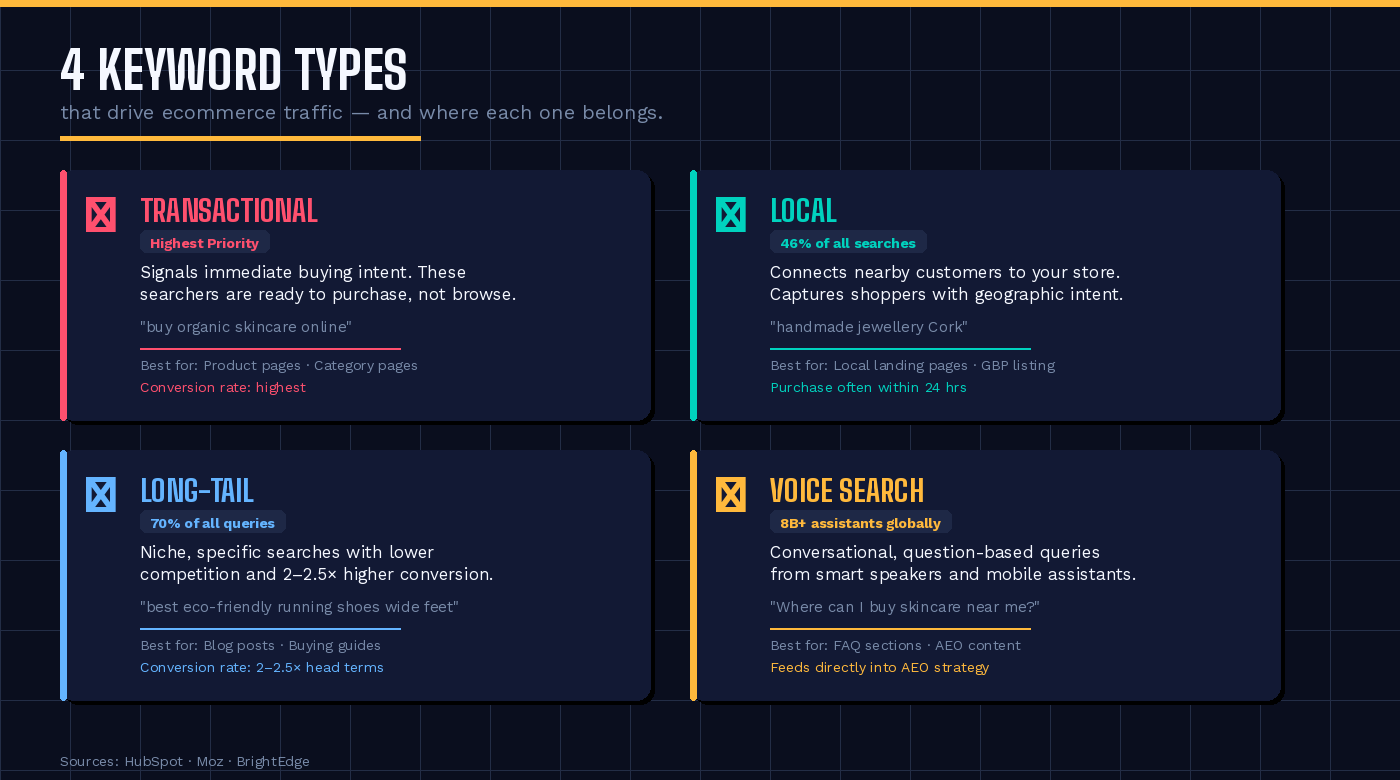
Not all keywords are equal. For ecommerce, four types matter most.
Transactional keywords signal immediate buying intent. Phrases such as 'buy organic skincare online' or 'best laptop deals' attract shoppers who are ready to purchase, not just browse. These are your highest-priority targets and belong primarily on product pages and category pages, because they sit closest to revenue.
Local keywords connect customers to your store by geography. Terms such as 'handmade jewellery Cork' or 'sports equipment Galway' capture shoppers searching with a specific location in mind. According to HubSpot, 46% of all Google searches carry local intent. Our hyperlocal keyword targeting service is designed specifically to capitalise on this, ensuring your store appears for the location-specific searches that drive ready-to-buy visitors.
Long-tail keywords target niche, specific searches with higher conversion rates. 'Best eco-friendly running shoes for wide feet' is far more likely to convert than 'running shoes.' Long-tail keywords account for around 70% of all search queries and frequently convert at 2 to 2.5 times the rate of head terms. Competition is lower, intent is clearer and the buyer is closer to a decision.
Voice search queries are increasingly important as more shoppers use smart speakers and mobile assistants. Industry forecasts suggest there will be well over eight billion voice assistants in use globally within the next couple of years. These queries tend to be conversational and question-based, such as 'Where can I buy organic skincare near me?' Optimising for natural, spoken language patterns is now a meaningful part of ecommerce keyword research and connects directly to Answer Engine Optimisation, which is covered later in this guide.
Mapping the right keyword type to the right page ties it all together. Transactional keywords belong on product and category pages. Informational and long-tail terms perform well for blog content and buying guides. Local keywords anchor your geo-targeted landing pages. Every page should own one primary keyword and support it with closely related terms, without competing with itself.
On-Page SEO Best Practices for Product Pages and Category Pages
On-page SEO is where most ecommerce SEO wins are made.
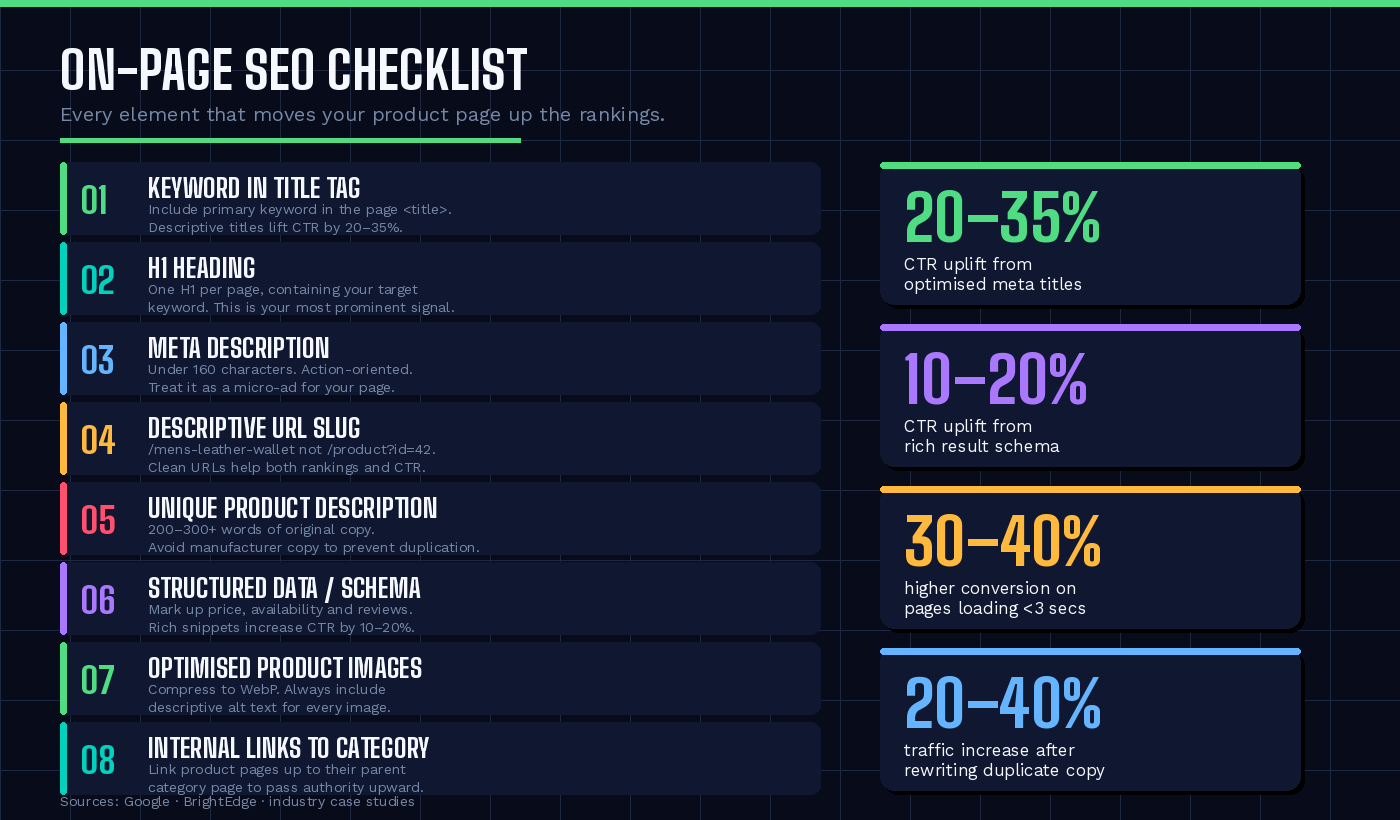
It covers every element you control directly on a page: titles, headings, product description copy, URL structure and internal links. For an ecommerce website, the product page is where on-page SEO has the most immediate impact on both ranking and revenue. Every product page should target a primary keyword and include that keyword in the title tag, H1, meta description and the opening paragraph of the product description. Our meta tag optimisation service handles this systematically across your entire catalogue. Well-optimised meta titles and descriptions alone can lift click-through rates by 20 to 35%, even if your ranking position does not change.
Write compelling, specific titles rather than generic ones. 'Men's Leather Wallet — Handmade and Sustainable' outperforms 'Leather Wallet' in both search rankings and click-through rates because it matches longer, more specific queries and stands out in crowded SERPs.
Category pages are equally important. They are also consistently under-optimised. A category page typically targets broader, higher-volume keywords and funnels shoppers towards specific products lower in the catalogue. Adding a short introductory paragraph with relevant keywords, optimising the page title and using descriptive URL slugs, for example /mens-running-shoes rather than /cat?id=42, all help Google and other search engines understand exactly what the page is about. Well-optimised category descriptions of even 75 to 150 words have been shown to improve rankings and organic traffic by double-digit percentages in competitive categories.
Structured data is one of the most powerful on-page tools available and one of the most underused. Our ecommerce structured data service implements schema markup for product name, price, availability and reviews so your listings can appear as rich results in the SERPs. That visibility drives click-through rates higher, often by 10 to 20%, without any change to your underlying ranking position.
Meta descriptions do not directly influence ranking. They do, however, strongly affect click-through rates from the search results page. Keep them under 160 characters. Make them action-oriented. Treat every single one as a micro-advertisement for the page it represents.
Images are often overlooked. Our SEO image optimisation service covers compression to WebP format and descriptive alt text for every image. Tests across ecommerce stores show that pages loading in under three seconds can see 30 to 40% higher conversion rates than slower equivalents. Short product demonstration videos embedded on key product pages improve both engagement and dwell time, two signals that search engines use to assess page quality.
How Does Technical SEO Impact Your Ecommerce Site's Ranking?
Technical SEO is the foundation. Without it, everything else struggles to perform.
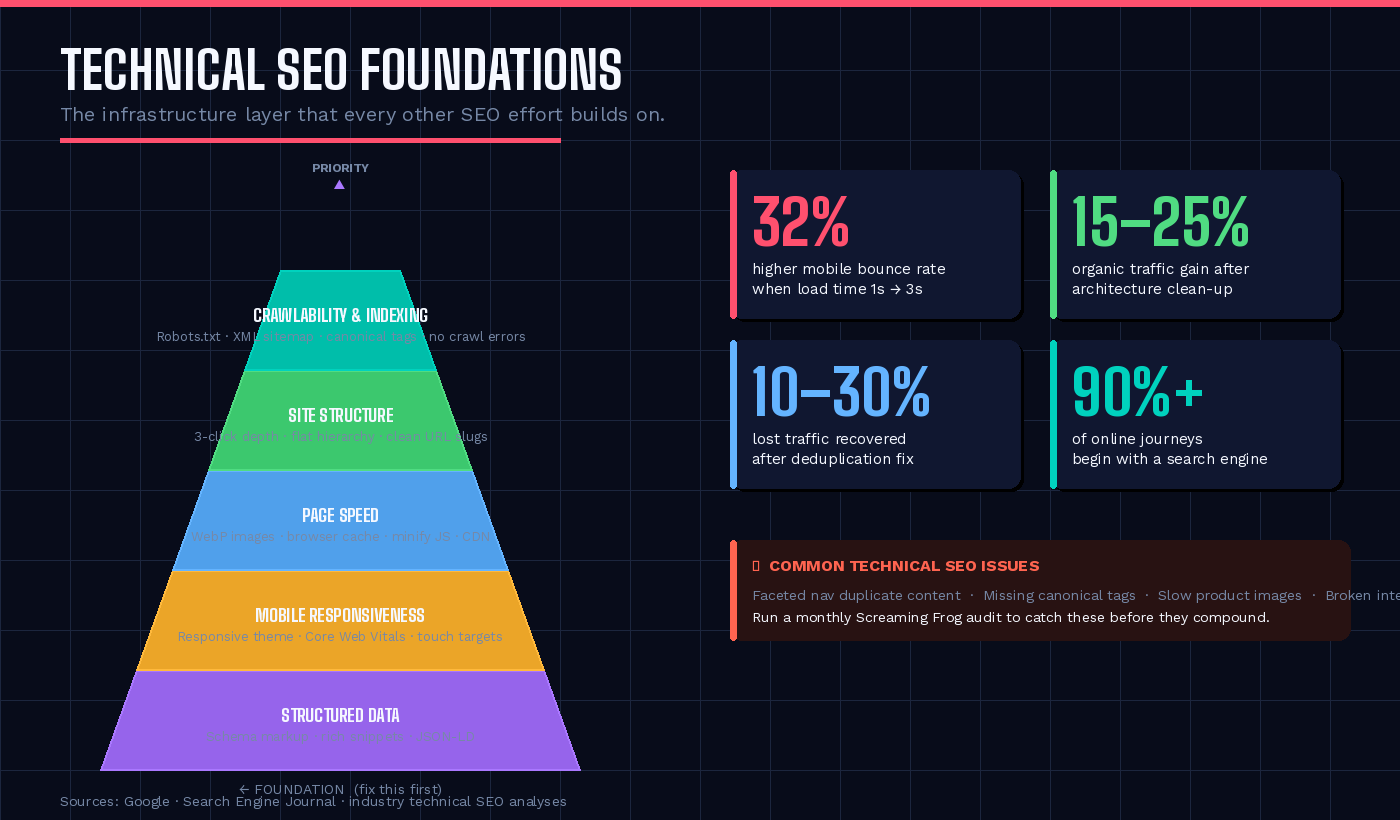
It refers to the behind-the-scenes optimisations that help search engines crawl, index and rank your pages correctly. For a large ecommerce site with thousands of product pages, technical SEO issues can silently devastate organic search performance long before anyone notices. Common problems include slow page load times, duplicate content from faceted navigation, broken links, missing canonical tags and poorly structured XML sitemaps. Our technical SEO services address all of these systematically, starting with a full SEO audit and analysis to establish your baseline.
Duplicate content and keyword cannibalisation deserve special attention on larger catalogues. When multiple pages compete for the same keyword, they dilute each other's authority and none ranks as well as one well-optimised page would. Canonical tags, consolidated category structures and careful internal linking all help prevent this from happening. Our robots.txt and sitemap XML optimisation service ensures crawlers see exactly what you want them to see. Recovering from deduplication fixes has been known to restore 10 to 30% of lost organic traffic.
Site structure matters enormously. A flat, logical architecture, where every important page is reachable within three clicks of the homepage, ensures search engine crawlers can discover all your pages efficiently. Sites that reduce click depth and clean up their architecture often see organic traffic improve by 15 to 25%. Use Google Search Console regularly to surface crawl errors, index coverage gaps and Core Web Vitals issues before they compound. For more on the relationship between speed and rankings, see our post on page speed and SEO.
Speed is non-negotiable. Google data shows that as page load time increases from one second to three seconds, the probability of a mobile visitor bouncing rises by 32%. Stretch that to five seconds and the bounce probability spikes by roughly 90%. More than 50% of all searches now happen on mobile devices. Our site speed optimisation service covers image compression, browser caching, JavaScript minification and CDN configuration to get your pages performing at their best.
What Role Do Product Descriptions Play in Ecommerce SEO?
Thin descriptions are one of the most common and most damaging SEO issues on ecommerce websites.
Search engines like Google penalise duplicate content on your website. Many online stores copy product descriptions directly from manufacturers, meaning dozens of competing sites carry identical copy. The result is that pages suppress each other, none of them ranking as well as they should. Case studies show that rewriting manufacturer copy with unique, brand-specific descriptions can deliver ranking and traffic increases of 20 to 40% for affected product sets. Our SEO copywriting service produces original, keyword-rich descriptions written specifically for your audience and your brand at scale.
Focus on benefits, not just specifications. Weave in the primary keyword and related search terms naturally, without forcing them. For an optimised product page, aim for at least 200 to 300 words of original copy. Pages with fewer than 100 words routinely see higher bounce rates and lower conversion rates, because shoppers simply do not have enough information to make a confident decision.
Product images matter too. Every image should carry descriptive alt text that includes relevant keywords. This helps Google understand your website's visual content, improves accessibility for all users and adds value in Google Image Search, which in some niches can account for 5 to 10% of organic visits.
How Can Site Structure and Internal Linking Strengthen Your SEO Foundation?
Think of internal linking as plumbing. Authority flows through it. Block it and your best pages suffer.
A deliberate site structure determines how search engine crawlers navigate your content and how link authority moves from high-authority pages down to important pages deeper in the catalogue. Your homepage typically carries the most authority. A well-designed internal linking strategy channels that authority into category pages and product pages where it can influence ranking directly. Our internal linking strategy service maps this out across your entire site, ensuring authority flows where it is needed most. Sites that implement clear, hierarchical internal linking often see category page visibility rise in double-digit percentages within a few months.
Internal links should use descriptive anchor text containing target keywords, not generic phrases like 'click here' or 'read more.' Link from high-traffic blog content and landing pages to relevant product and category pages. Also link between related product pages and from category pages down into individual products. Breadcrumb navigation is particularly valuable for ecommerce sites: it creates clear, predictable paths through the site structure, improves user experience and appears as rich snippets in Google search results, increasing click-through rates by up to 10%.
Prioritise the pages on your website that are commercially valuable but currently under-performing. A category page for a high-margin product line with few internal links is starved of the crawl attention and authority it needs. Fixing this costs nothing and can produce meaningful ranking gains without a single word of new content being written.
How Does Content Marketing Help Your Ecommerce SEO?
A blog is not just for storytelling. It is a traffic engine.
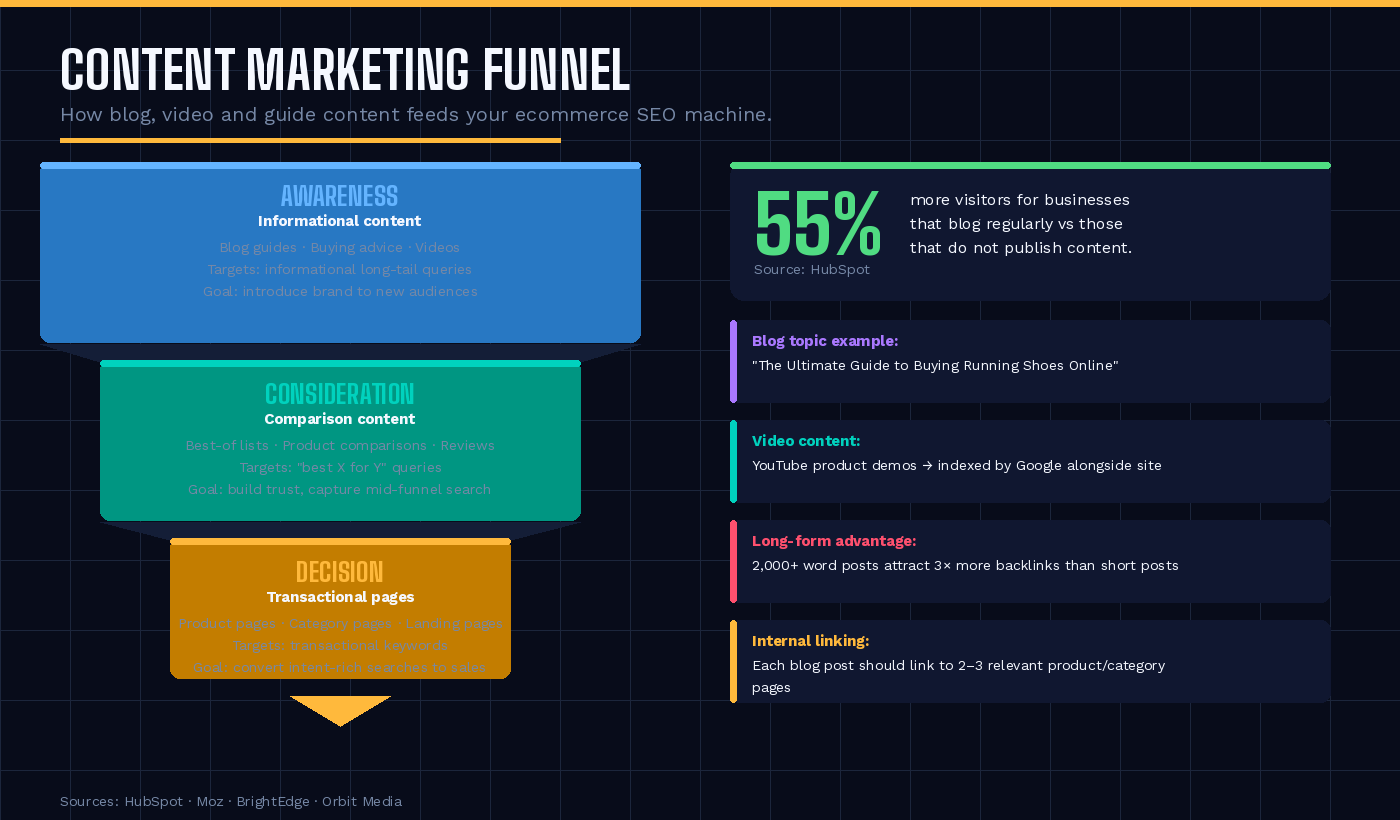
High-quality editorial content answers the questions your customers are already searching for, brings in organic traffic at the awareness stage and builds the topical authority that helps your product and category pages rank for commercial keywords. Businesses that blog regularly generate around 55% more visitors and 67% more leads than those that do not publish content at all. Our SEO blog writing service produces content that is structured for both readers and search engines, with every post linked strategically to your key commercial pages.
The key is choosing topics that connect directly to your catalogue. A sustainable fashion brand might publish a guide to ethical manufacturing. An outdoor retailer could run a series on choosing the right walking boots for different terrains. A tech accessories store might compare the best laptop cases for commuters. Each article targets informational keywords at the top of the purchase funnel, introduces the brand to new audiences and links naturally to relevant product and category pages. Long-form content of 2,000 words or more is far more likely to attract backlinks than shorter posts. Our content formatting for readability service ensures every piece is structured in a way that keeps readers engaged and satisfies search engine quality signals.
Video content amplifies the effect. Posting product demonstration videos on YouTube, which is owned by Google, creates an additional indexed asset in search results alongside your website. Customer reviews and testimonials embedded in content build trust and social proof, improving conversion rates once shoppers reach your product pages.
Is Local SEO Relevant for Ecommerce Businesses?
More than most people think.
Local SEO is highly relevant for ecommerce businesses with physical locations, click-and-collect options or region-specific product lines. When shoppers search for products 'near me' or in a specific town, local SEO signals, including a verified Google Business Profile, consistent NAP (name, address, phone) data and dedicated local landing pages, help your ecommerce site appear in both the local pack and standard organic search results simultaneously. Our Google Business Profile setup and optimisation service ensures your profile is fully optimised and actively maintained.
Even purely online retailers can benefit. An e-commerce store can rank for location-specific searches by building dedicated landing pages with localised keyword research and regionally relevant copy. We have helped businesses across Ireland do exactly this, from SEO in Dublin and SEO in Cork to SEO in Galway and SEO in Limerick. You can view our full range of locations on our all locations page. For more on why local signals matter to rankings, see our guide on how local SEO affects your search rankings.
According to Google, 76% of people who search for something nearby on a smartphone visit a related business within 24 hours. For ecommerce businesses with physical locations, that statistic alone justifies the investment. Local SEO and ecommerce SEO strategies are not in competition; aligned correctly, they reinforce each other and drive revenue both online and in store.
What Are the Most Effective Off-Page SEO Tactics for Ecommerce Sites?
Backlinks remain one of the strongest ranking signals Google uses.
Off-page SEO covers everything outside your ecommerce website that influences how search engines rank your pages. When authoritative sites link to your product pages, category pages or editorial content, search engines treat those links as external votes of confidence. The more high-quality links you earn, the more trust and authority your ecommerce site accumulates. Our link building and backlink acquisition service focuses exclusively on earning high-authority, relevant links that move rankings rather than short-term gains that invite penalties.
The most sustainable approach is earning links through content that is genuinely worth linking to. Product guides, original research, interactive tools and detailed comparison articles all attract natural backlinks from bloggers, journalists and industry publications. Our digital PR and media outreach service pitches data-driven stories to relevant media at scale. Avoid paid link schemes entirely: Google's algorithms are sophisticated enough to detect and penalise manipulative link building, and the consequences can be severe. For more on what works and what to avoid, see our in-depth guides on link building and toxic backlinks.
Supplier and manufacturer relationships are an often-overlooked off-page SEO lever. Many suppliers list their authorised retailers on their own websites. Those links, modest as they may seem, carry real authority and cost nothing to obtain.
What Is Answer Engine Optimisation and Why Should Ecommerce Stores Care?
Search is changing. AI is driving that change.
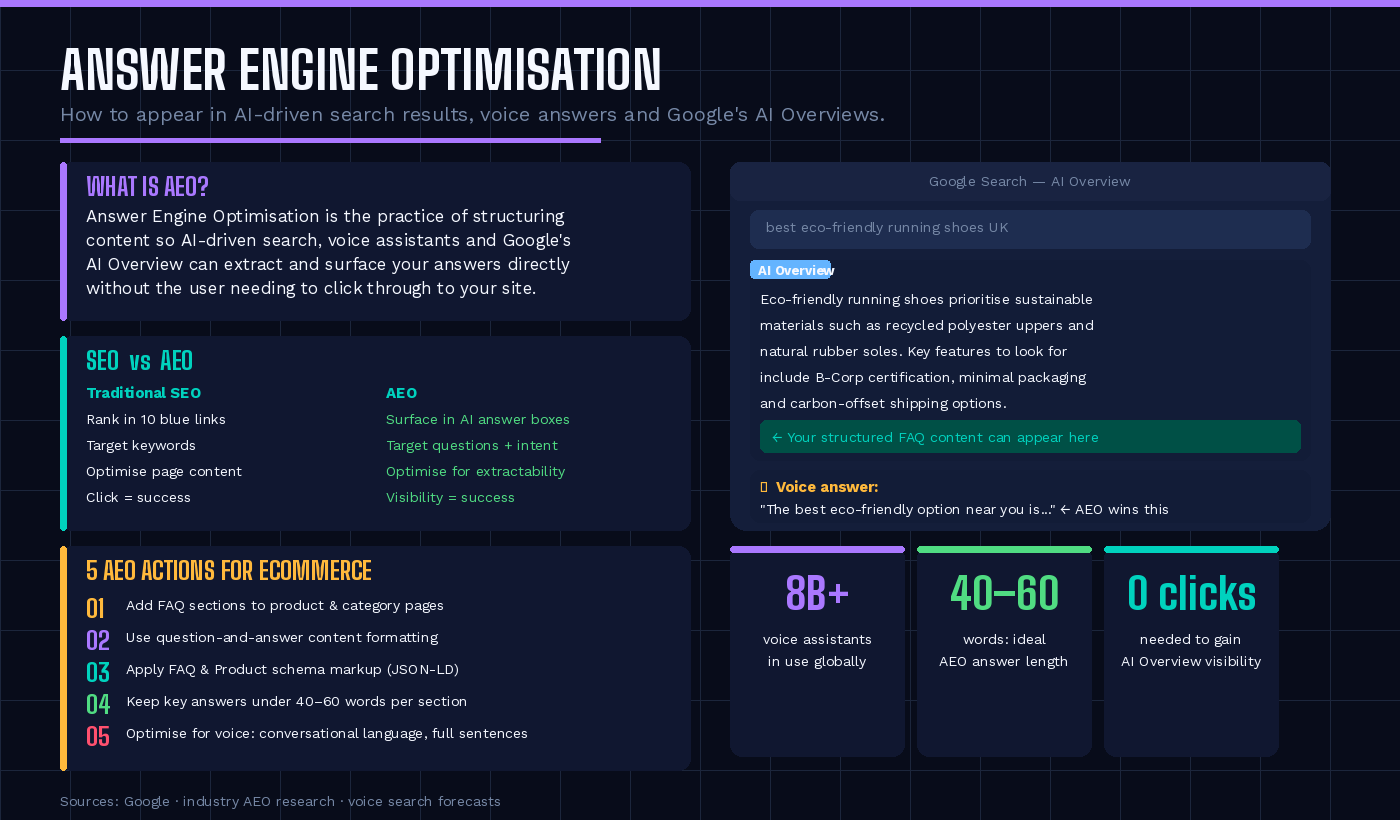
Google's AI-powered search now surfaces direct answers at the top of results pages before a single traditional organic listing appears. Answer Engine Optimisation, or AEO, is the practice of structuring your content so that AI-driven search tools, voice assistants and generative results can extract and surface your answers directly. Our blog covers this in detail, including how to get your business listed in ChatGPT and Google AI Overviews, how to SEO your website for ChatGPT and how to outrank competitors in AI search.
For ecommerce, the practical steps are straightforward. Add an FAQ section to your key product and category pages, using the exact questions your customers ask in real language. Format content in a clear question-and-answer structure wherever possible. Our schema markup and structured data service implements FAQ, product and review schema so that AI systems can identify and use your content confidently. Keep your most important answers concise and direct, ideally within the first 40 to 60 words of a section.
This is not a separate strategy. It is an extension of good SEO practice applied to the new reality of how people search. For a deeper look at how AI is changing local and ecommerce search specifically, see our post on how AI is reshaping local SEO.
Which Ecommerce SEO Tools Should You Use to Measure and Improve Performance?
You cannot improve what you do not measure.
Google Search Console is the most important free SEO tool available to any ecommerce site. It surfaces which search queries are generating impressions and clicks, identifies which pages are indexed and flags whether Google can crawl your site without errors. Pair it with Google Analytics and you have a complete picture of how organic traffic behaves across your entire ecommerce site, from the initial landing page all the way through to checkout. Our analytics and SEO reporting service sets this up and delivers clear monthly reporting so you always know exactly what your SEO investment is producing.
For deeper analysis, paid ecommerce SEO tools such as Ahrefs, Semrush and Moz are the industry standard. They enable comprehensive keyword research, backlink analysis, rank tracking and full site auditing in a single platform. Screaming Frog SEO Spider is indispensable for technical SEO audits: it crawls your entire ecommerce site and flags duplicate content, broken links, missing meta descriptions and redirect chains that quietly erode your overall SEO health over time.
Use the tools consistently. Schedule monthly SEO audits. Track keyword ranking movement weekly. Review Search Console data regularly. The best ecommerce SEO outcomes do not come from one-off bursts of activity; they come from building continuous improvement into your team's ordinary working rhythm.
How Do You Build a Successful SEO Strategy That Scales With Your Ecommerce Business?
Scale is the central challenge. And it requires a different mindset.
Begin with an SEO audit and analysis. Establish your baseline: what is already ranking, what has technical SEO issues and where the largest keyword gaps are. Use that audit to build a prioritised roadmap. Our SEO roadmap creation service gives you a clear 6 to 12-month plan built around your specific catalogue, competitive landscape and revenue targets, balancing quick wins with longer-term investments in content marketing and link acquisition.
An ecommerce platform with thousands of SKUs cannot rely on manual optimisation for every product page. Build templates, guidelines and automation into your workflow so that SEO best practices are embedded into every new product listing from day one. The choice of ecommerce platform matters here. WooCommerce offers greater flexibility for custom SEO configurations; our WooCommerce SEO service is tailored to its specific technical requirements. Shopify is a more accessible starting point with built-in SEO-friendly features. Our Shopify SEO checklist for Irish businesses walks through platform-specific optimisation step by step. Either way, structured data is a particularly powerful scalable tactic that helps Google understand your website's products, reviews and prices, and can unlock rich snippets that dramatically increase click-through rates.
Finally, treat SEO as part of your broader ecommerce marketing strategies, not a separate project. Content built for organic search supports email campaigns, social media and paid channels. Conversion rate optimisation insights improve user experience across every touchpoint. Research by Terakeet found that organic search can deliver a cost-per-acquisition up to 87% lower than paid search for ecommerce businesses. That figure captures precisely why strong, consistent ecommerce SEO is not an expense. It is a compounding asset. If you are ready to build that asset, our SEO agency Ireland team is here to help.
Frequently Asked Questions
How long does it take to see SEO results for an ecommerce store?SEO is a long-term strategy. Most stores see noticeable improvements within three to six months, but competitive industries can take up to twelve months before rankings stabilise meaningfully. The earlier you start, the sooner the compounding effect begins. See our detailed breakdown of how much SEO costs and what to expect at each investment level.
Is local SEO important if I only sell online?Yes. Many customers search for businesses in their country or region before making a purchase. Optimising for location-specific search terms can help you rank for queries you would otherwise miss entirely. Read our full guide on local SEO Ireland for practical steps.
Which is better for ecommerce SEO: Shopify or WooCommerce?Both platforms have strong SEO capabilities. See our dedicated Shopify SEO checklist for Irish businesses and our WooCommerce SEO service for platform-specific guidance. Is WordPress a good option for ecommerce? We cover that too in our post on whether WordPress is good for ecommerce.
Do I need a blog for my ecommerce site?A blog significantly improves your search rankings, builds topical authority and drives organic traffic by targeting informational keywords that product and category pages cannot capture alone. Our SEO blog writing service can handle content production end to end.
How can I track my SEO progress?Use Google Analytics and Google Search Console as your baseline. Add Ahrefs or Semrush for keyword rank tracking and backlink monitoring. Our analytics and SEO reporting service provides clear, regular reporting tied directly to business goals rather than vanity metrics.
Key Takeaways: Ecommerce SEO Essentials
- Ecommerce SEO is the process of optimising your online store to rank higher in organic search results, driving qualified traffic and improving conversion rates without ongoing ad spend.
- Organic search accounts for 53% of all website traffic and 46% of Google searches have local intent, making SEO the single most important channel for most ecommerce businesses.
- Use the right keyword types: transactional for product pages, local for geo-targeted pages, long-tail for niche traffic and conversational formats for voice search.
- Optimise every product page and category page with a target keyword in the title tag, H1, meta description and URL. Use structured data to unlock rich results in the SERPs.
- Technical SEO, including site speed, mobile responsiveness, crawlability and duplicate content prevention, is especially critical for large ecommerce websites.
- Unique, original product descriptions are non-negotiable: copy-pasted or manufacturer descriptions are one of the most common SEO issues hurting ecommerce rankings.
- Content marketing, including blogs, videos and interactive tools, attracts organic traffic at the awareness stage and builds the topical authority that lifts your commercial pages.
- Internal linking distributes authority from high-traffic pages to important product and category pages, strengthening your overall SEO foundation at no extra cost.
- Off-page SEO through high-quality backlinks remains one of the strongest ranking signals. Earn links through great content and digital PR rather than paid schemes.
- Answer Engine Optimisation (AEO) is increasingly important: structure your content with clear FAQs, question-and-answer formatting and schema markup to appear in AI-driven search results.
- Use ecommerce SEO tools such as Google Search Console, Semrush and Screaming Frog to track SEO performance and surface issues before they escalate.
- Treat SEO as a continuous, integrated part of your ecommerce strategies. Consistent effort compounds into lasting ranking improvements and revenue growth.