



Starting with €500 can feel small when competitors spend more. It is enough, but only if you spend it on one thing. Split across Google, Facebook, Instagram and a leaflet drop it buys four campaigns, each too small to teach you anything.
You cannot outspend the bigger companies. What you can do is pick one channel, one offer, and a page that converts the click you already paid for.
Should you invest in paid advertising with €500?
Yes, if you need customers within 30 days.
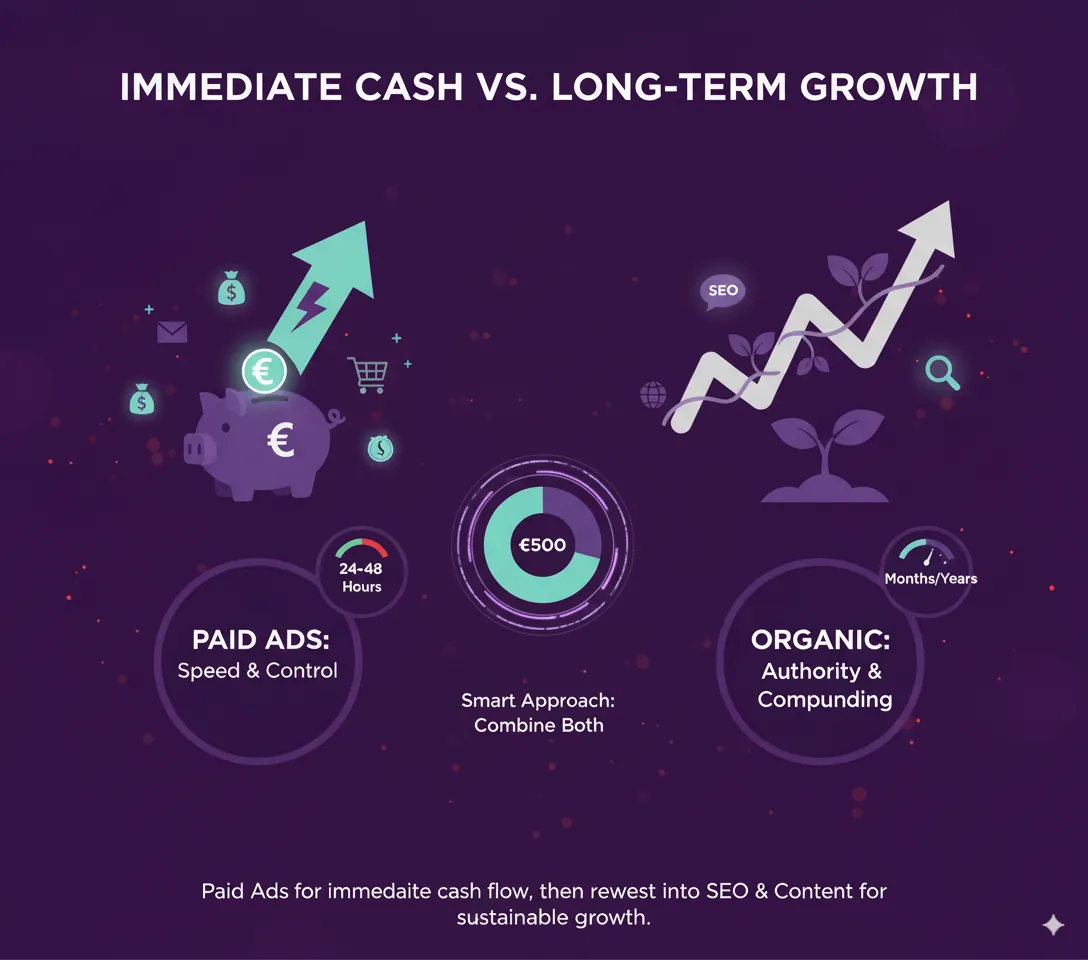
Think of advertising like this: Paid ads are renting attention. You pay, you get traffic, but stop paying and the traffic stops. Organic marketing is earning attention. It takes longer, but traffic builds over time and continues even when you pause.
More money chasing the same attention tends to push auction prices up, which is why precision matters more at €500 than at €5,000.
The smart path combines both approaches. Start with paid advertising to create immediate cash flow, then reinvest profits into SEO, local optimisation, and email marketing. This creates sustainable growth where you’re not perpetually paying for every website visitor.
What that looks like in arithmetic: €500 over a month at a €1 click buys roughly 500 visits. If one visit in twenty becomes a customer, that is 25 customers. Whether that is a good month depends entirely on what a customer is worth to you over a year, which is a number you can work out.
What Irish businesses actually spend on advertising
Irish businesses spent €1.146 billion on digital advertising in 2025, 8% more than the year before. In 2020 the figure was €655 million, so the market has grown by about 12% a year since 2020.
Where that money goes tells you where the competition is, which matters more to you than the total:
| 2025 Irish digital ad spend | Amount | Share |
|---|---|---|
| Display | €735m | 64% of all spend |
| Social media, which sits inside display | €576m | 78% of display |
| Search | €345m | 30% of all spend |
| Classifieds | €66m | 6% of all spend |
| Video, counted across all of the above | 39% of all spend |
Two lines there are worth a small business owner’s attention. Social is the largest part of display, so that is where most of the competition for attention sits. Video is 39% of all spend. If you can shoot decent video on a phone, you can compete in that part of the market without a production budget.
Figures from IAB Ireland’s online adspend study for 2025, as reported in Irish trade press.
Step 1, set one clear marketing goal
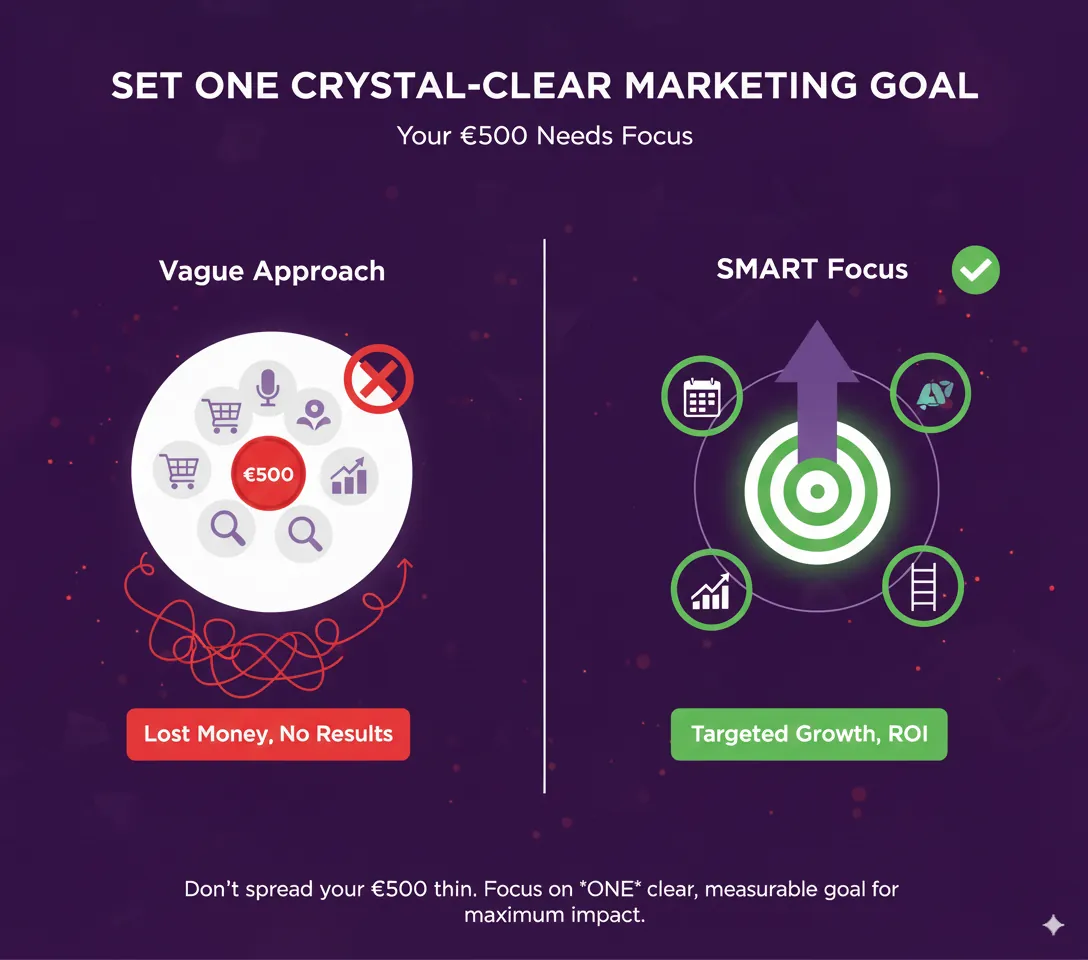
Your €500 budget evaporates when spread across multiple outcomes. Successful campaigns focus on one specific, measurable result that directly impacts revenue.
Lead generation goals work for service businesses: phone calls for emergency services, quote requests for contractors, and email signups for consultants offering valuable content.
Sales goals suit direct commerce: online orders for e-commerce, appointment bookings for restaurants and salons, and store visits for retail showrooms.
Brand awareness goals focus on qualified engagement: website traffic from target demographics, local social media interaction, and video views for product demonstrations.
Use the SMART framework for precision. Instead of “get more customers,” try “generate 15 consultation bookings for tax planning services within 30 days using €500 budget targeting Galway business owners.” That version tells you what to target, what to spend, what to count and when to stop. The vague version tells you none of those, which means that at the end of the month you cannot say whether it worked.
Step 2, analyse how customers currently find you
Your most recent 20-30 customers provide useful intelligence about where to invest your €500 most effectively. Past customer behaviour is a good guide to how people will find you next.
Ask three questions: How did you first hear about our business? What convinced you to choose us over competitors? Where do you typically search when needing services like ours?
Some patterns come up often:
Service businesses like plumbers, electricians and cleaners usually find search dominates, because a burst pipe gets typed into a phone rather than browsed for. If your own answers point that way, most of the budget belongs in Google Ads and your Google Business Profile.
Retail and e-commerce usually splits more evenly, because people buy things they were not searching for. These businesses tend to need budget in both search and social rather than committing to one.
Restaurants, salons and hotels run on maps, reviews and Instagram, because people choose where to eat by looking at it. Your Google Business Profile photos do more work here than any ad you will write.

Those are tendencies, not measurements. The answers from your own last twenty customers beat every industry average ever published, including these, because they describe your market instead of an average of everybody’s.
Apply the matching principle: If 70% of customers discover you through Google, allocate approximately €350 there, with the remaining budget for retargeting and complementary channels.
Step 3, competitor research
Your competitors have already invested thousands in testing what works in your local market. Instead of repeating expensive experiments, benefit from their learning through strategic intelligence gathering.
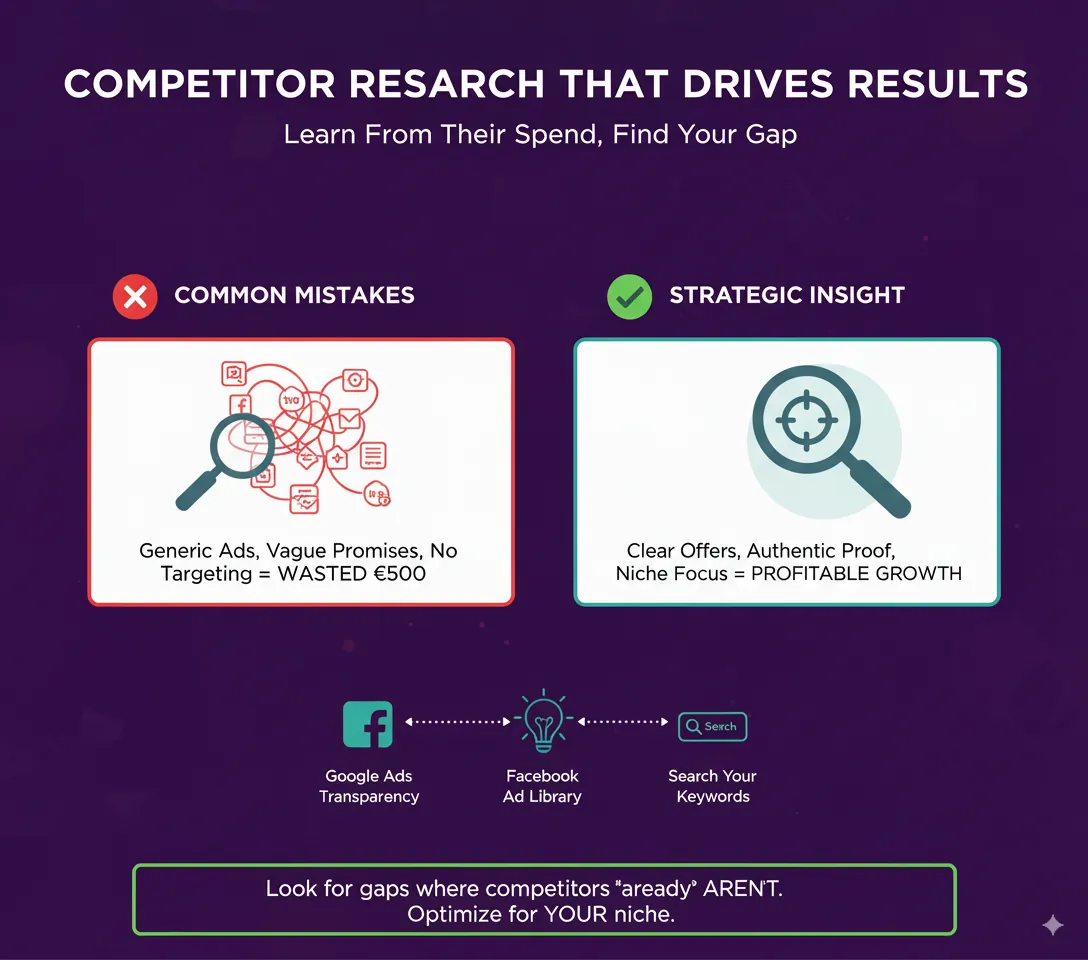
Use free competitive intelligence tools effectively. Google’s Ads Transparency Center at adstransparency.google.com shows the ads a competitor has run, though not the keywords behind them. Facebook’s Ad Library at facebook.com/ads/library shows current social media campaigns when filtered by Ireland.
For deeper analysis, paid tools go further. SEMrush’s Advertising Research shows competitors’ keywords and ad copy, which saves time compared with checking by hand.
Look for patterns across multiple competitors. If three different local competitors run Google Ads for “kitchen renovation Cork” and all emphasise showroom visits, that’s valuable intelligence about what converts in your market. If everyone’s running seasonal postcard campaigns, they probably found it paid off.
Gap analysis delivers the biggest opportunities. Say a fitness studio in Cork finds that no competitor is targeting women over 40. A gap like that can be worth more than any clever bidding strategy, for the simple reason that there is nobody bidding against you.
Step 4, choose your marketing channels
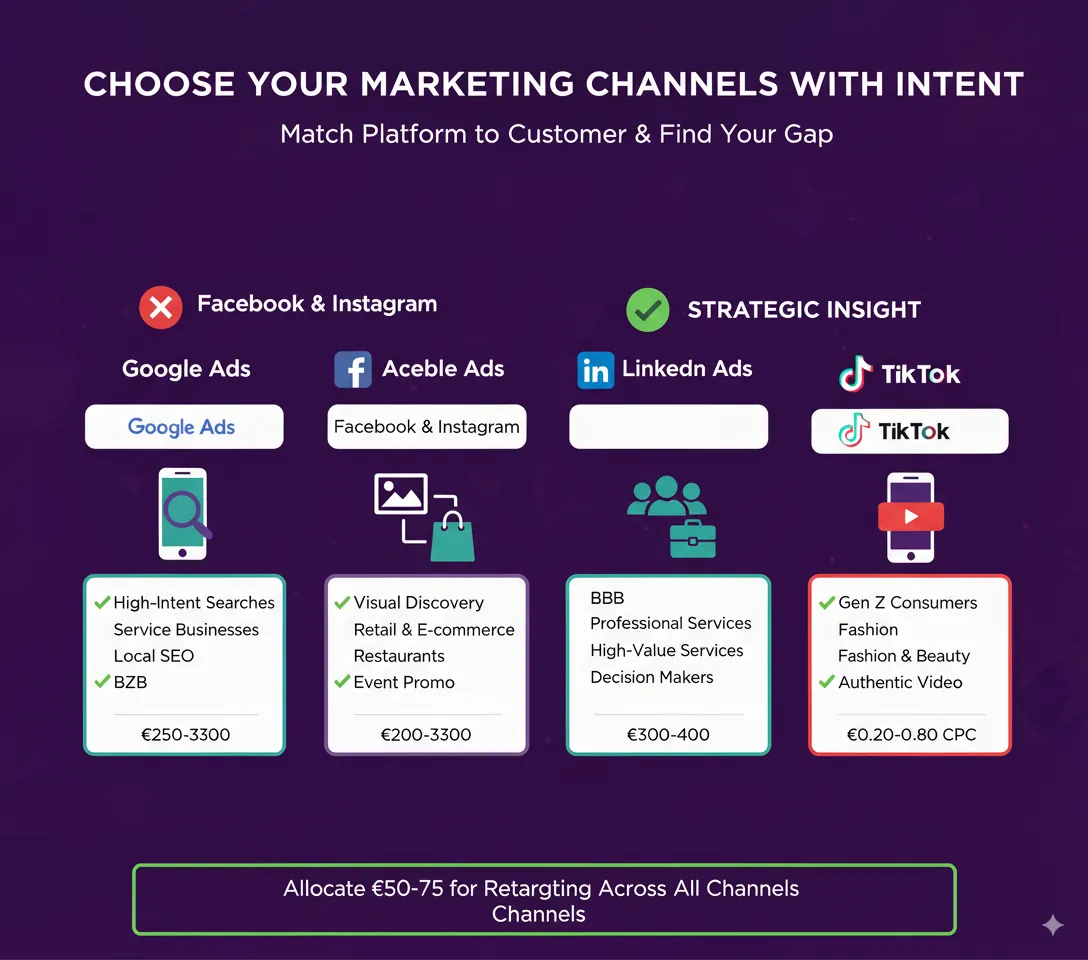
With €500, you cannot effectively cover every platform. Success requires matching channel selection to customer intent and business model rather than spreading resources thinly across multiple unproven channels.
Google Ads excels for high-intent searches where potential customers actively seek your services. This platform works well for service businesses, local searches including “plumber near me,” and sales worth a few hundred euro or more. A slow page on a phone wastes paid clicks. Our guide to how much Google Ads costs has the detail. Businesses with strong customer lifetime value should allocate €250-€350 here.
Facebook and Instagram suit visual businesses for restaurants, beauty products, retail items, and event promotion. DataReportal’s Digital 2026 report for Ireland puts Instagram use at 62.9% of adults, a large share of the audience you would want to reach. Our guides to Facebook and Instagram costs have the detail. Budget €200-€300 here if your work photographs well.
LinkedIn serves B2B professional services, including consultants, accounting firms, and corporate training providers. Clicks are dear, so it only makes sense when one client is worth thousands. At €500 the budget buys too few clicks to learn anything from. Come back to LinkedIn when you can commit €1,000 a month.
TikTok is worth testing if you already shoot short video and your customers are under 35, particularly in fashion, beauty, food and entertainment. It is not where to start at €500 unless video is already something you make every week, because the ads only work when they look like the platform rather than like advertising.
Always include retargeting with €50-€75 budget to re-engage warm visitors who showed initial interest but need additional touchpoints before converting.

Fix where the clicks land before you spend a cent
Clicks are not customers, and the cheapest click is rarely the best value. A cheap click that lands on a slow page is worth less than a dearer click that lands on a page built to answer the question that was typed. That is a common mistake before anyone spends a cent.
This is the cheapest win available to you, and it costs nothing to check. Put your address into Google’s PageSpeed Insights and read the mobile score, not the desktop one. For the main content to appear, Google’s “good” mark is 2.5 seconds or less. If your page is slower than that on a phone, fix it before you raise your ad budget, because you will get more from the same spend afterwards.
The rest of the list is short. Send traffic to one page per offer rather than your homepage. Make the phone number a tap-to-call link. Cut the form to three fields. Put the price, or at least the range, somewhere on the page. And use the same words in the ad as on the page, so the visitor knows immediately that they landed in the right place. If that is more than you want to take on yourself, it is the kind of thing our web design work exists to fix.
Step 5, focus on one hero product or service
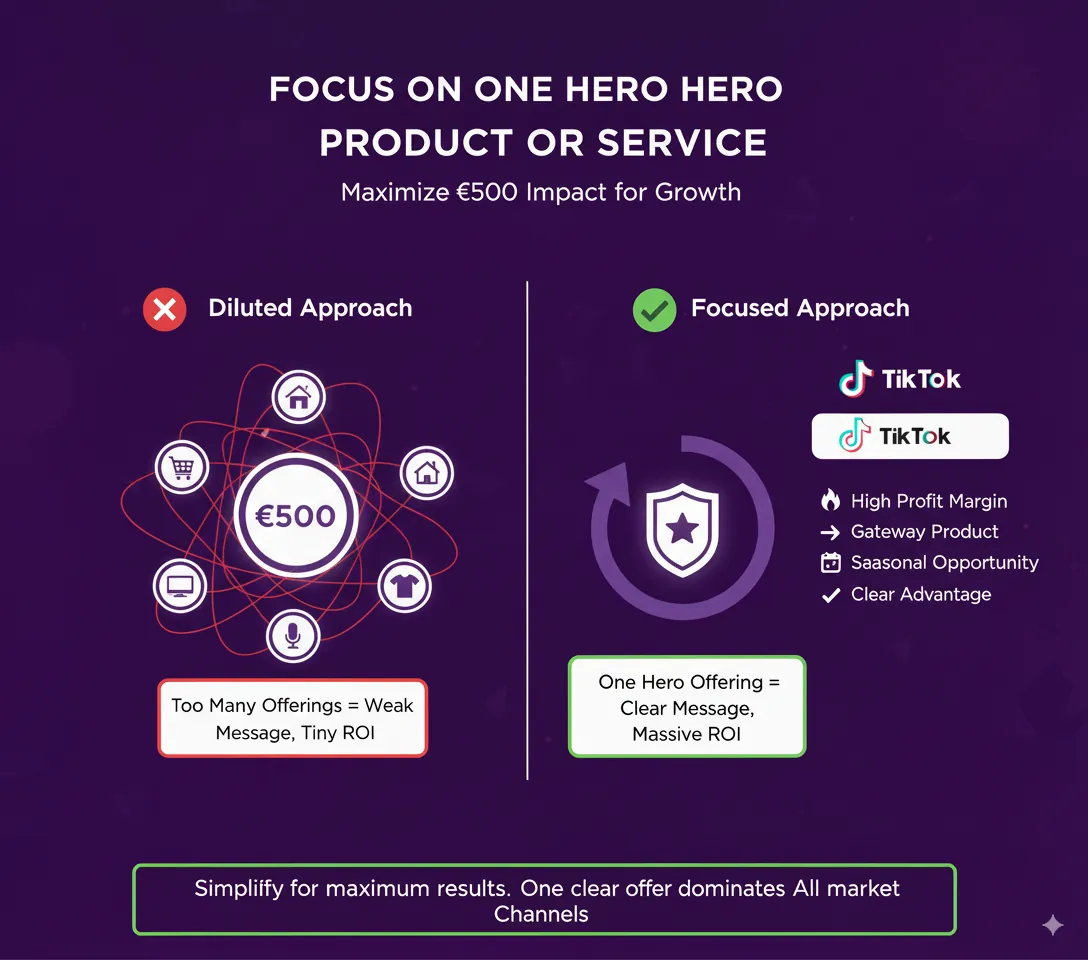
Spreading your €500 across multiple offerings dilutes impact and complicates tracking. Concentrate on one hero offering that maximises conversion potential and business growth.
Selection criteria for maximum impact: Choose products or services with high profit margins (target 60%+ to support advertising costs), gateway potential that leads to larger purchases or ongoing relationships, seasonal demand with natural buying cycles, or clear competitive advantages where you outperform rivals.
Specific beats broad, every time. A web designer advertising “web design services” is bidding against every agency in the country, for people who might want anything. The same designer advertising “e-commerce websites for Irish retailers” is bidding against a handful, for people who already know what they want and roughly what it costs. The second campaign should cost less per lead, and the leads should be better.
The same logic applies to a cleaning company. “Cleaning services” competes with everyone and attracts people shopping on price. “Post-construction cleaning” usually has fewer rivals, can carry a higher hourly rate, and reaches builders who need it booked this week.
One hero product simplifies everything: advertisement creation, landing page optimisation, conversion tracking, and performance analysis. This clarity leads to better results and easier scaling decisions.
Step 6, create offers that convert Irish customers
Even perfectly targeted traffic fails without compelling offers that address Irish consumers’ primary concerns and motivations.
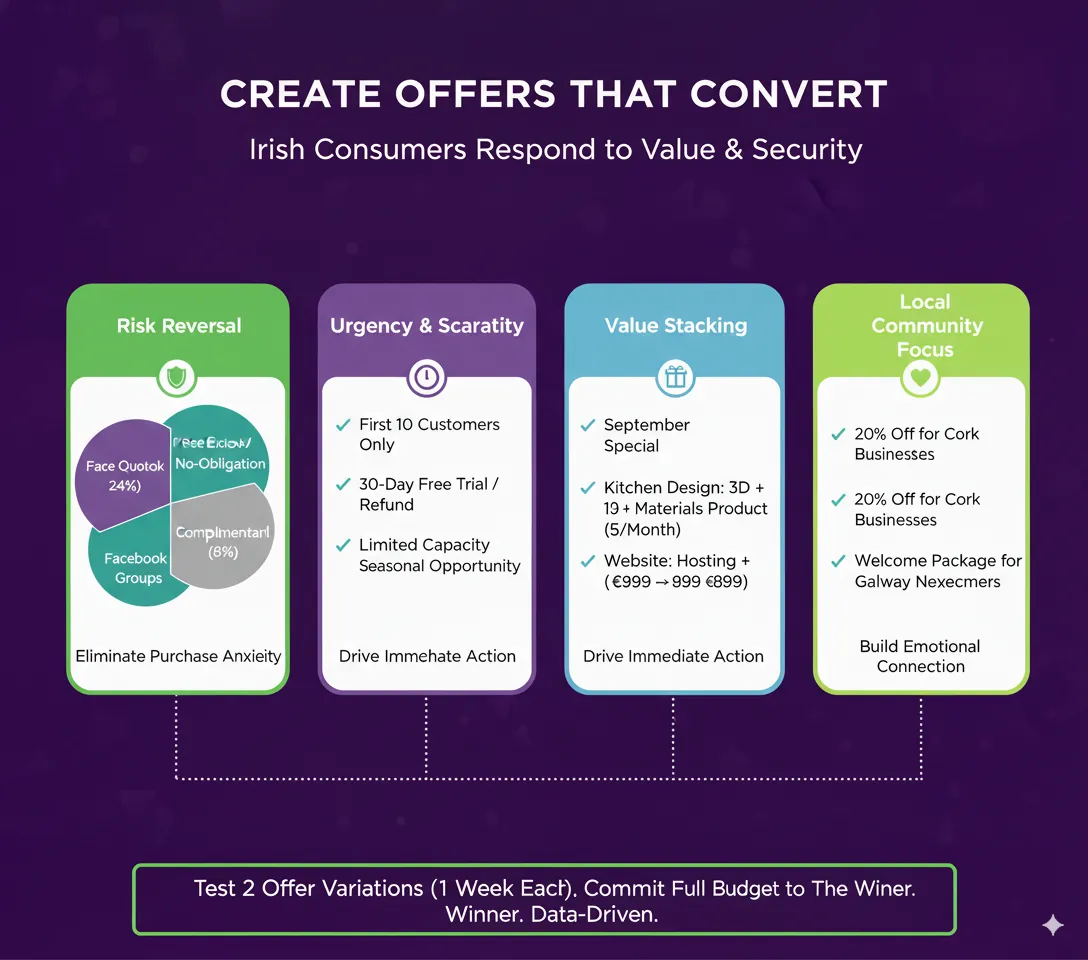
Risk reversal offers work well for many small businesses. Examples include quotes with no obligation, 30-day trial periods with full refunds, or a short assessment with no obligation. These approaches can ease purchase anxiety and show confidence in the service.
Urgency combined with genuine scarcity creates immediate action. Limited offers for the first 10 customers, September specials requiring month-end booking, or capacity restrictions of 5 monthly projects drive quick decision-making. Ensure these limitations are authentic rather than artificial to maintain credibility with sceptical Irish consumers.
Value stacking demonstrates comprehensive service while justifying pricing. For example, a complete kitchen design, including 3D visualisation and material lists, sold for one price rather than item by item, shows clear savings. A website bundle that combines hosting and a year of maintenance into one price shows the same kind of saving.
Local focus often works well for businesses that serve their own town. Offers supporting Cork businesses with a discount for local companies, or welcome packages for Galway newcomers, create emotional connections beyond price competition.
Test two offer variations for one week each with equal budget allocation, then commit the remaining funds to the winner. This simple A/B test helps you find your strongest value proposition.

Step 7, build ads that convert Irish customers
Your ad is competing with everything else in the feed, much of which is also selling something. It has to say who it is for and what they get in the first line, before the reader decides to keep scrolling.
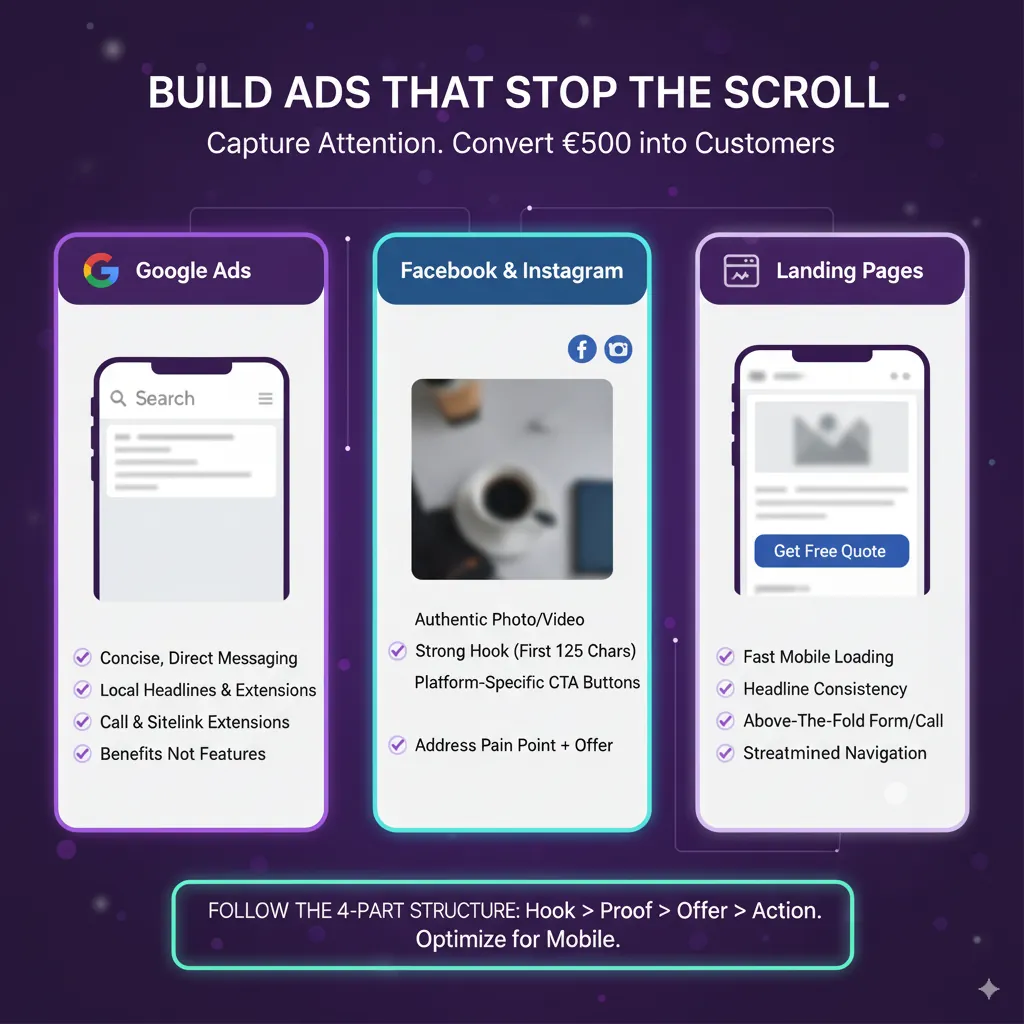
A simple four-part structure works well for most ads: Start with a hook addressing local context or specific outcomes your customers want. Provide proof through customer results, brief testimonials, or credibility indicators. Present your offer with clear value and genuine deadline pressure. End with one obvious action step that removes friction.
Google Ads require concise, direct messaging that matches search intent. Headlines are limited to 30 characters, while descriptions focus on benefits rather than features. Include location extensions showing your address, call extensions for immediate phone contact, and sitelink extensions highlighting specific services. Incorporate your town name and “near me” intent phrases that Irish consumers actually search for.
Instagram and Facebook ads demand visual excellence combined with compelling copy. Use authentic photography of your actual work, products, or team rather than generic stock imagery. The first 125 characters must compel users to continue reading since mobile feeds truncate longer copy after this point. Utilise platform-specific call-to-action buttons like “Get Directions” for local businesses rather than generic “Learn More” options.
Landing pages must deliver on advertisement promises with technical excellence. Ensure the main content loads on a phone within 2.5 seconds, the “good” mark in Google’s Core Web Vitals, headline consistency with advertisements, above-the-fold phone buttons or contact forms, clear address and map for physical visits, and streamlined navigation without menu overload.
Example transformation demonstrates the difference quality makes:

- Before: “Quality cleaning services available. Call now for the best prices. Professional team.”
- After: “Busy Dublin professionals: Come home to a spotless house every Friday. Our insured team cleans while you’re at work. First clean €45 (normally €75). Book your Friday slot before the month-end.”
The improved version immediately identifies target customers, addresses their specific needs, provides clear value, and creates genuine urgency.
Step 8, how to split the budget
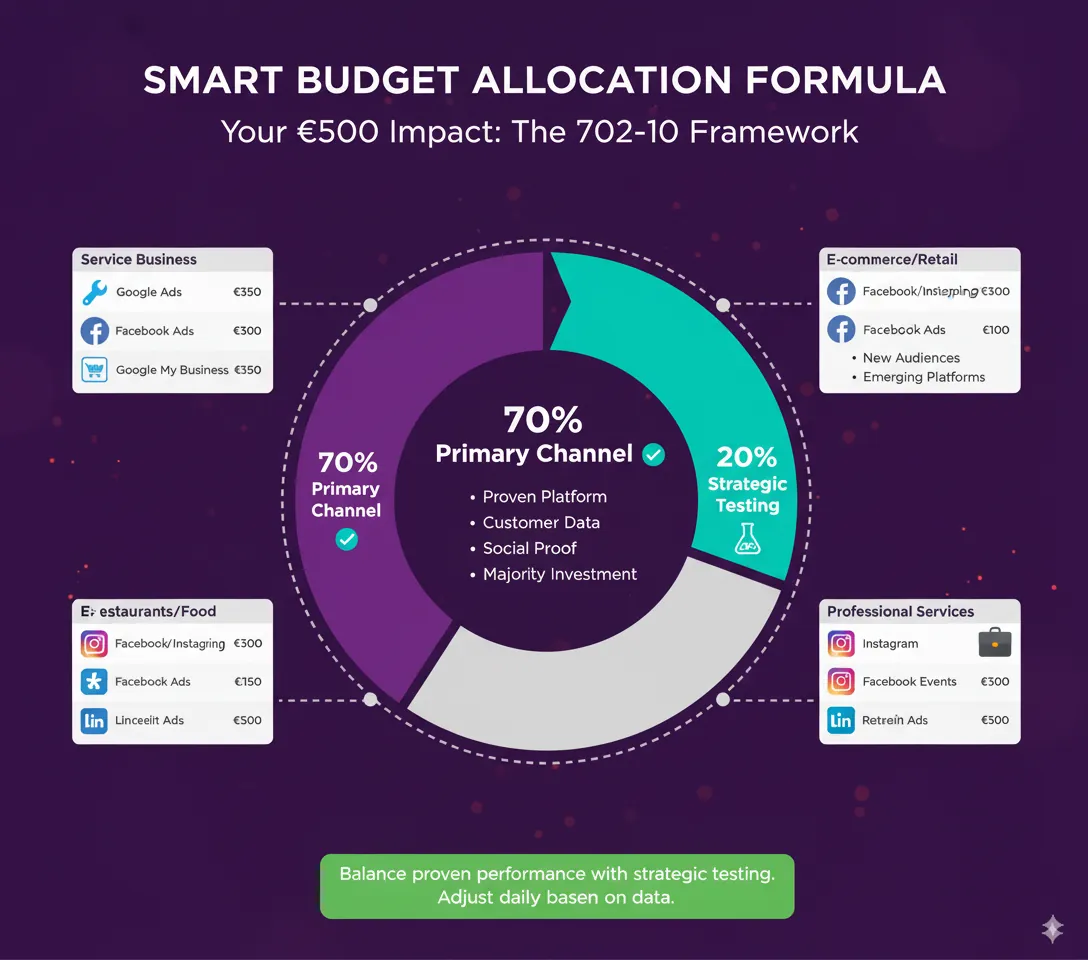
Strategic budget distribution maximises your €500 impact through a 70-20-10 split that balances what already works with testing.
Allocate 70% (€350) to your primary channel based on customer discovery data, meaning the platform where your customers already demonstrate they search for and purchase your services.
Dedicate 20% (€100) to a secondary channel that provides complementary reach or social proof without diluting focus from your primary investment.
Reserve 10% (€50) for testing new audiences, placements, or emerging platforms. This enables strategic experimentation without risking core performance.
Budget allocation examples by business type:
A plumber or electrician could split the €500 with €350 to Google Ads targeting local intent keywords, €100 to Facebook Ads for emergency services and local community engagement, and €50 to Google Ads for map visibility and call clicks.

An e-commerce or retail business could distribute €300 to Facebook and Instagram catalogue or video advertising showcasing products, €150 to Google Shopping campaigns for product searches, and €50 to retargeting campaigns for website visitors who didn’t complete purchases.
A restaurant could invest €250 in Instagram advertising featuring food photography, €150 in Facebook Events promoting special nights and offers, €50 in Google Ads for local searches, and €50 in testing TikTok’s behind-the-scenes content capabilities.
A professional services firm, such as a legal or accounting practice, could concentrate €400 on Google Ads for high-intent searches, €50 on LinkedIn Ads for industry-specific targeting, and €50 on retargeting to nurture website visitors through longer decision cycles.
Daily budget management divides €500 over 30 days into €16.67 daily spending. The launch sequence in Step 9 explains how to ease in.
The €5,000 Grow Digital Voucher
If you employ between 1 and 50 people, your Local Enterprise Office runs the Grow Digital Voucher. It covers 50% of eligible costs up to €5,000, with a €500 minimum.
Read what it covers before you get excited. A website built for you is excluded, so check the eligible list on the Local Enterprise Office page first.
It is still worth a phone call, because the voucher can cover some of the software behind the site your ads point at, once you have checked the eligible list.
You have to discuss it with your Local Enterprise Office and be approved before you spend anything, so it is a call to make before the campaign rather than after it.
Step 9, how to launch
Coordinated campaign launches provide clean performance data and prevent budget waste through systematic testing protocols that ensure fair comparison between channels.
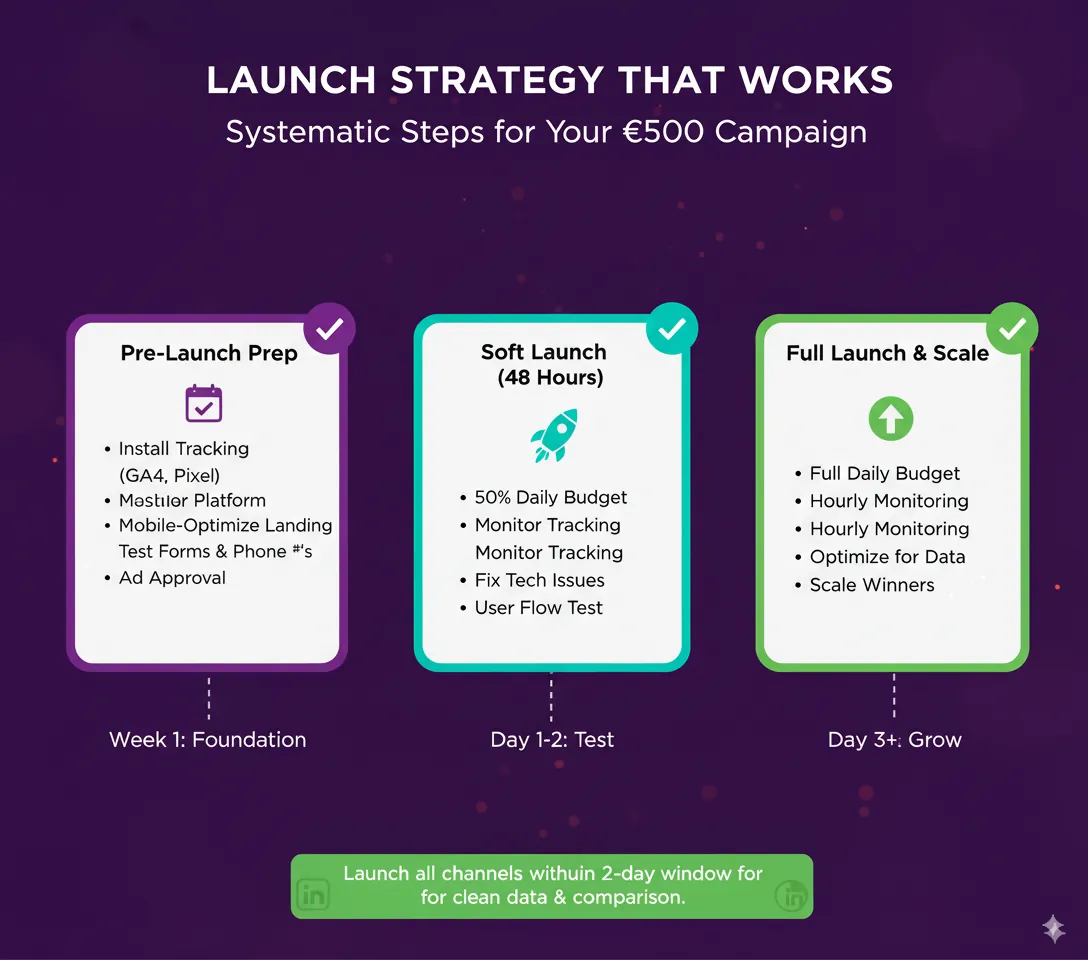
Launch all chosen channels within a 48-hour window to ensure comparable market conditions and accurate performance comparison between platforms. When Google ads launch Monday, Facebook ads Wednesday, and postcards arrive the following week, you’re testing three different market conditions rather than true channel effectiveness.
Pre-launch preparation ensures smooth deployment: Confirm Google Analytics 4 and Meta Pixel installation with working conversion tracking. Verify landing pages load quickly on mobile devices and phone numbers enable click-to-call functionality. Test contact form submissions and email notifications. Ensure advertisement copy and imagery meet platform approval requirements and compliance standards.
Coordinated launch execution begins with soft testing: Use 50% of planned daily budgets for the first 48 hours to identify and resolve technical issues before full investment. Monitor conversion tracking functionality, landing page performance, and user flow completion without making optimisation changes during this initial period.
Scale to complete daily budgets from day three onward while tracking performance metrics daily. Avoid making adjustments based on early performance fluctuations. Focus on identifying obvious technical problems rather than premature optimisation during the first week.
Set your pause and scale rules before launch, from the cost per lead you can afford. Pause a campaign that stays well above that figure after a fair test, and give more budget to one that consistently beats it.
Step 10, measure what matters
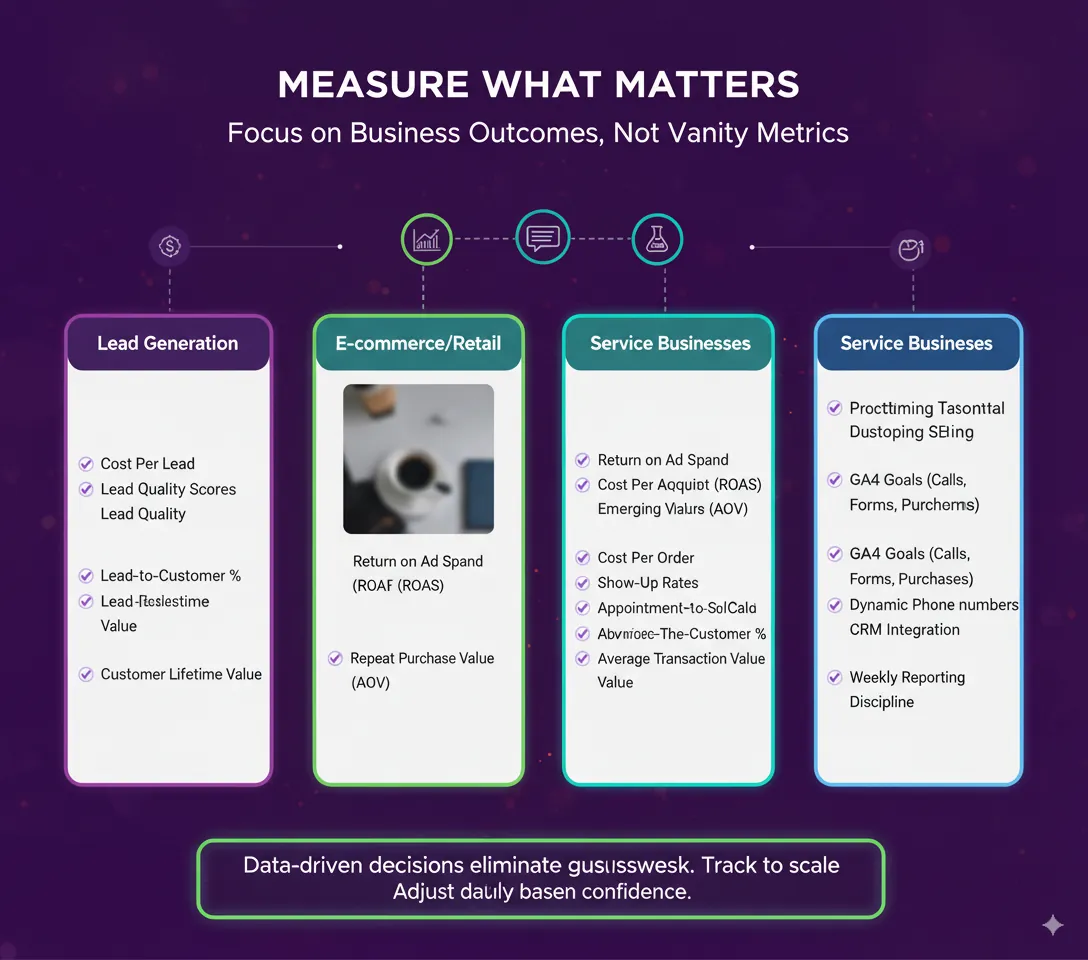
Focus measurement on business outcomes that directly impact your bottom line rather than vanity metrics that look impressive but don’t drive growth or revenue.
Track one core outcome per channel to maintain clarity and actionability:
For Google search advertisements, monitor “Get Directions” clicks, phone calls exceeding 30 seconds, and contact form submissions. Google Ads provides detailed reports showing clicks, impressions, cost-per-click, and conversion actions with attribution data.
For Facebook and Instagram advertisements, track call-to-action button taps, direct messages, and website click-throughs with engagement quality. Facebook Ads Manager shows comprehensive performance data, including reach, engagement, and cost per result with demographic breakdowns.
For offline advertising, including postcards or local radio, create trackable elements such as unique promo codes customers must mention in-store, dedicated phone numbers for each campaign, or systematically ask every new customer, “How did you hear about us?” and log responses for analysis.
The tracking you need: Google Analytics 4 conversions for calls exceeding 30 seconds, form submissions, email signups, purchase completions, and appointment bookings. Dynamic phone numbers by channel enable accurate call attribution. Simple CRM integration connects advertising leads to actual sales revenue for true return on investment calculation.
Weekly reporting discipline maintains optimisation momentum: Track total advertising spend against targets, leads generated compared to goals, cost per lead trends, actual conversions to paying customers, and revenue generated from advertising investment.
Calculate return on ad spend (ROAS) by dividing the revenue from your ads by what you spent on them. Then set your target from your margin. At a gross margin of 33.3%, each €1 of ads needs €3 of sales to break even, so a 200% return (€2 for €1) still loses money.
Step 11, optimisation and scaling
After 7 to 14 days of data, you can start to optimise.
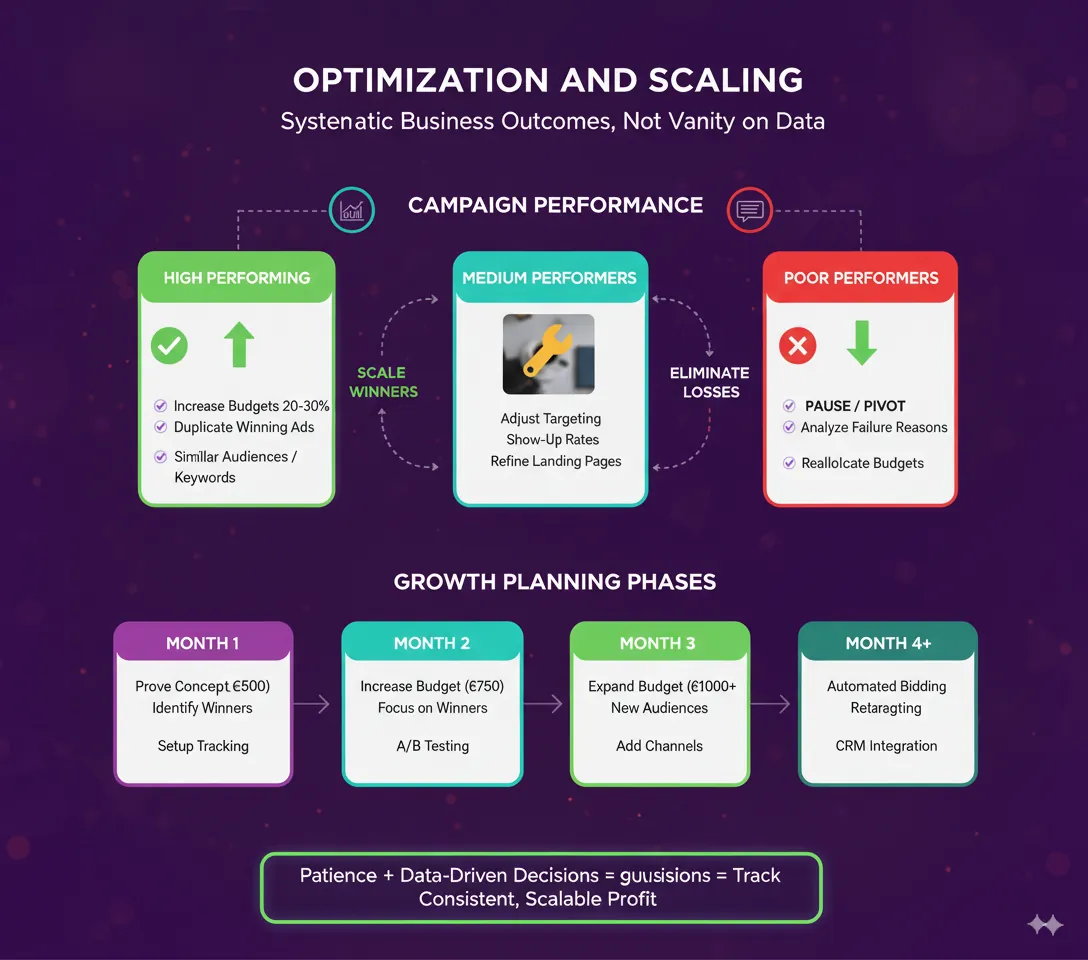
High-performing campaigns deserve increased investment. Scale successful campaigns by increasing budgets 20-30% daily while creating similar audiences or expanding keyword targeting. Duplicate winning advertisements with minor variations to prevent ad fatigue while maintaining performance levels.
Medium performers require strategic adjustments rather than replacement. Tighten audience targeting parameters, test new advertisement imagery or opening copy, and optimise landing page clarity and conversion elements. These campaigns often improve significantly with focused optimisation rather than a complete overhaul.
Poor performers should be paused when costs exceed three times your target cost per lead. Analyse the failure first, whether that is the wrong channel, weak targeting, a weak offer or a poor landing page, before reallocating budgets to the best performers. Document lessons learned for future campaign planning.
Systematic growth planning follows predictable phases: Month 1 proves concept viability with €500 budget while identifying winning campaigns and building proper conversion tracking. Month 2 increases to €750, focuses spending on the best performers, and begins systematic A/B testing of variations. Month 3 expands to €1,000+ budget, tests new audiences and keywords, and adds complementary advertising channels. Month 4 implements automated bidding strategies, expands retargeting audiences, and integrates CRM revenue data with advertising platforms.
Professional help becomes valuable when spending exceeds €200 without generating conversions, when you cannot accurately track which advertisements drive actual sales, when daily campaign monitoring becomes impossible due to time constraints, or when technical setup problems prevent proper optimisation and scaling.
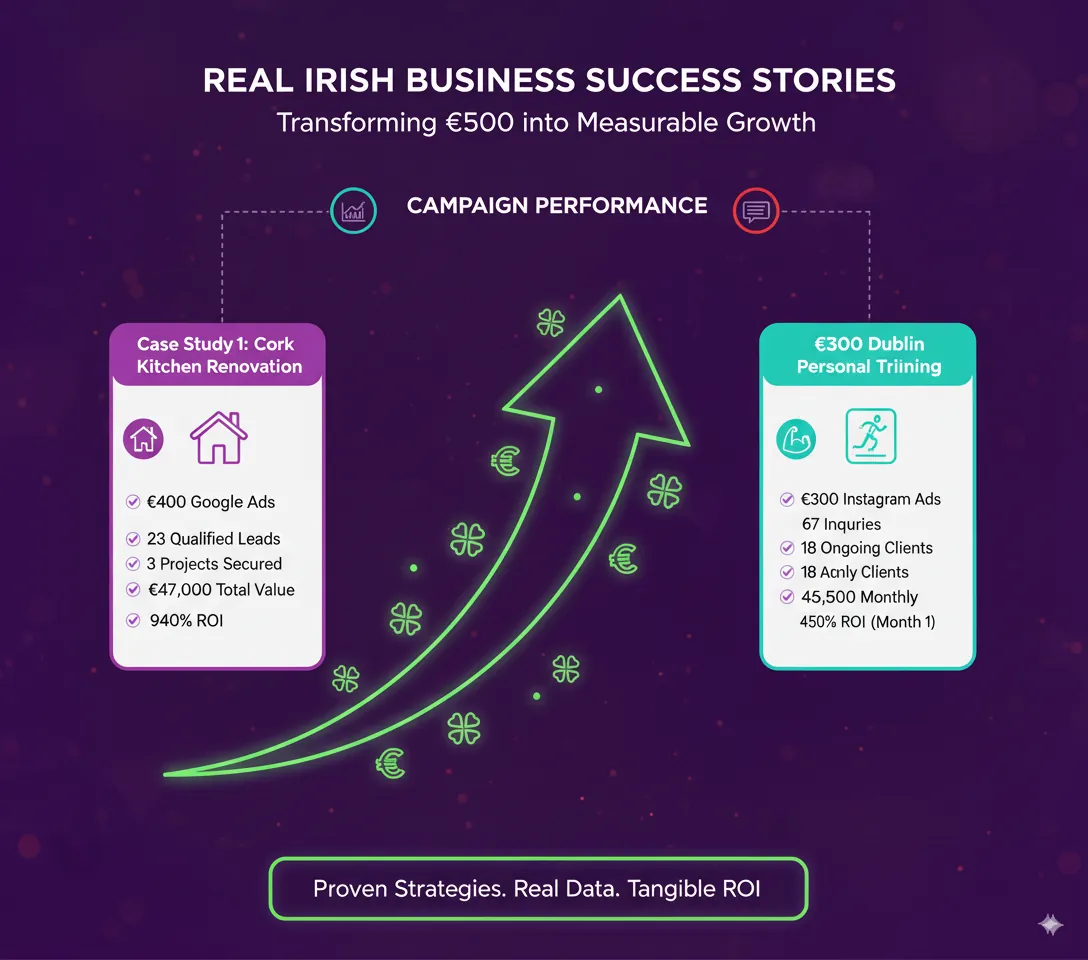
Two worked examples
Neither of these is a client case study. They are the arithmetic worked through for two common Irish small businesses, so you can see where the money goes and what has to be true for it to pay.
A kitchen renovation company in Cork
The problem: a new business competing against companies with decades of reputation and far bigger budgets.
The plan: €400 to Google Ads on “kitchen renovation Cork” and similar searches, €100 to Facebook retargeting people who already visited the site. One service only, complete kitchen makeovers. The offer is a 3D design consultation, with no obligation.
The arithmetic: kitchen keywords in a city are competitive, so assume €3 a click. That means €400 buys roughly 130 clicks. If one in ten asks for the consultation, that is 13 enquiries. If a third of those turn into consultations and one of those becomes a job, the campaign needs a job with more than €500 of gross profit to break even. A full kitchen can clear that, which is why this kind of business suits paid search.
What decides it: photographs of kitchens you actually finished, bidding on complete makeovers rather than small repairs, and ringing people back the same day. The last one costs nothing.
A personal training studio in Dublin
The problem: a crowded market, premium pricing and no brand recognition.
The plan: €300 to Instagram targeting a specific group in specific suburbs, €200 to Google Ads on “personal trainer Dublin”. One offer, a four-week programme, and a first session with no obligation to take the risk out of it.
The arithmetic: this is the opposite case to the kitchen company, and the difference is the whole lesson. A client is worth perhaps €200 a month rather than €15,000 once, so no single sale repays the campaign. What repays it is how long they stay. At €200 a month a client who stays six months brings in €1,200 in revenue, so one or two of those covers the €500. Work out your average client lifespan before you set a budget, because on a membership model that one number decides everything else.
What decides it: a specific audience rather than “people in Dublin”, real before-and-after photographs of real clients, and something that turns the first session into a booked month.
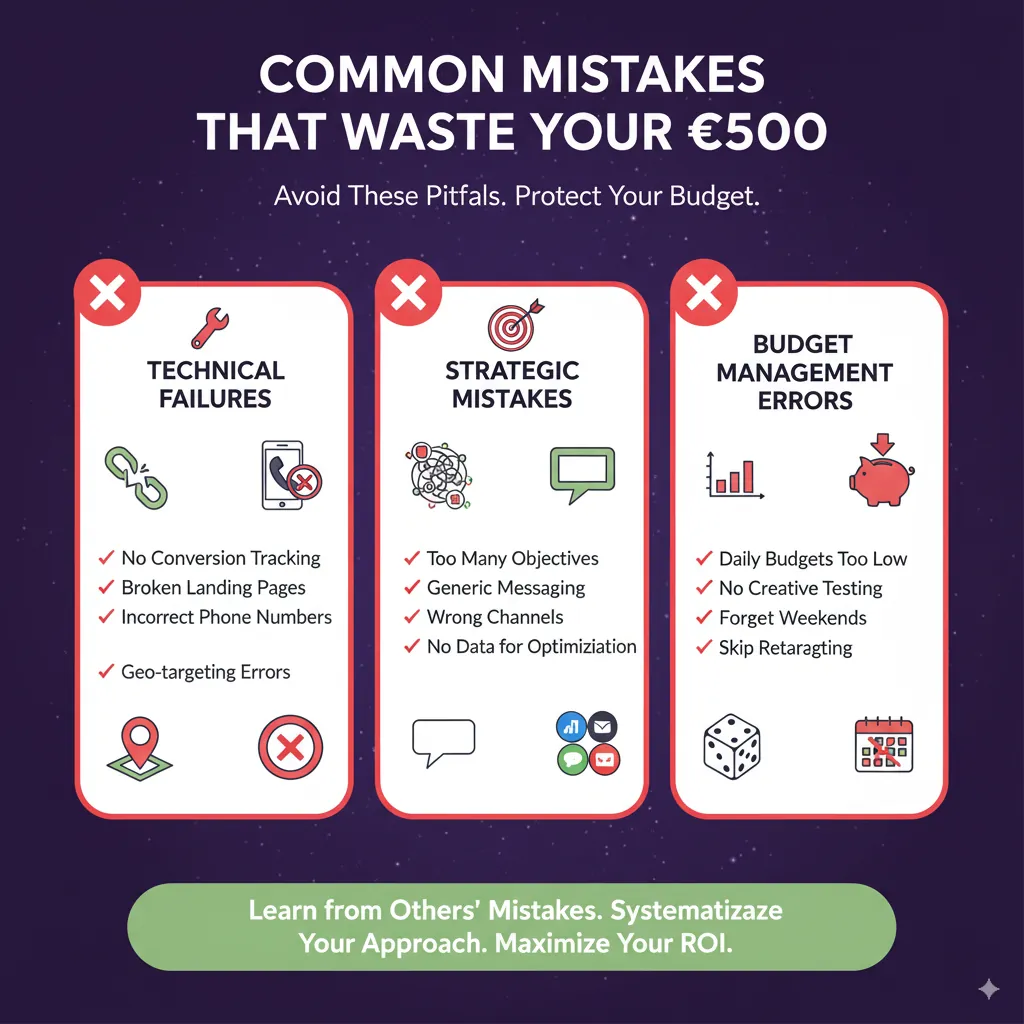
Common mistakes that waste your €500
Technical failures destroy campaigns before they begin: Running advertisements without conversion tracking leaves you blind to performance data. Broken landing pages that load slowly or aren’t mobile-optimised waste every paid click. Incorrect phone numbers in advertisements result in missed calls and lost sales opportunities. Geo-targeting errors that advertise to the wrong locations burn budget on unqualified traffic.
Strategic mistakes undermine otherwise sound campaigns: Pursuing multiple objectives simultaneously spreads your €500 too thin to create meaningful impact. Generic messaging that mirrors every competitor fails to differentiate your business. Selecting wrong advertising channels that don’t match audience behaviour wastes money on platforms where customers aren’t active. Making optimisation changes before gathering sufficient performance data prevents understanding what actually drives results.
Budget management errors sabotage well-planned campaigns: Setting daily budgets too low, such as €5 per day, results in being overwhelmed by larger competitors and fails to generate adequate data for optimisation. Testing only one creative approach means one poor advertisement can destroy the entire campaign performance. Forgetting to advertise on weekends can miss peak research and decision-making periods. Failing to allocate retargeting budget loses warm prospects who need additional touchpoints to convert.
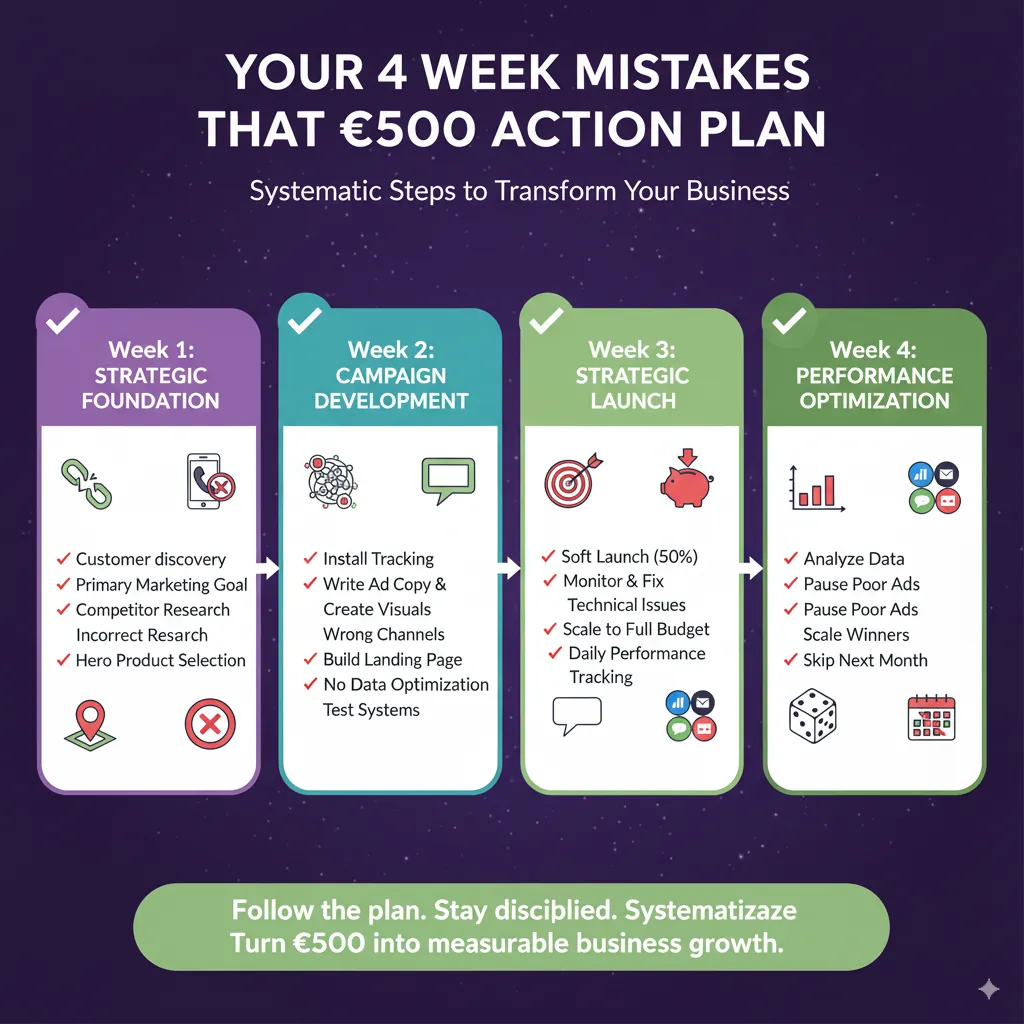
Your four-week €500 action plan
Week 1: strategic foundation. Complete customer discovery audit by surveying recent buyers about their discovery and decision process. Select one primary marketing goal that aligns with immediate business needs and revenue objectives. Analyse your top three local competitors using free tools and identify their messaging gaps and opportunities. Choose your hero product or service that offers the best combination of profit margin, market demand, and competitive advantage.
Week 2: campaign development. Install and configure tracking systems, including Google Analytics 4 and platform pixels, with proper conversion goals. Write compelling advertisement copy following a hook, proof, offer and action structure with a local Irish context. Create or source authentic visual content that represents your business professionally and builds credibility. Build one focused landing page that matches advertisement promises and optimises for mobile conversion with clear contact methods. Test all contact forms and phone systems to ensure proper functionality and immediate response.
Week 3: strategic launch. Begin with a soft launch using 50% of the planned daily budgets to identify and resolve technical issues before full investment commitment. Monitor campaigns closely for conversion tracking problems, user experience issues, or technical malfunctions that could waste budget. Scale to full budget allocation while tracking performance daily and documenting initial learnings for future optimisation and campaign improvement.
Week 4: performance optimisation. Analyse comprehensive performance data to identify winning and losing campaign elements. Pause underperforming advertisements that exceed cost per lead targets and reallocate budget to successful campaigns. Increase budgets for campaigns showing positive return on investment while testing variations of winning approaches. Plan next month’s expanded strategy based on the results and documented success factors. Calculate actual return on investment and document successful approaches as templates for future campaigns and business growth.
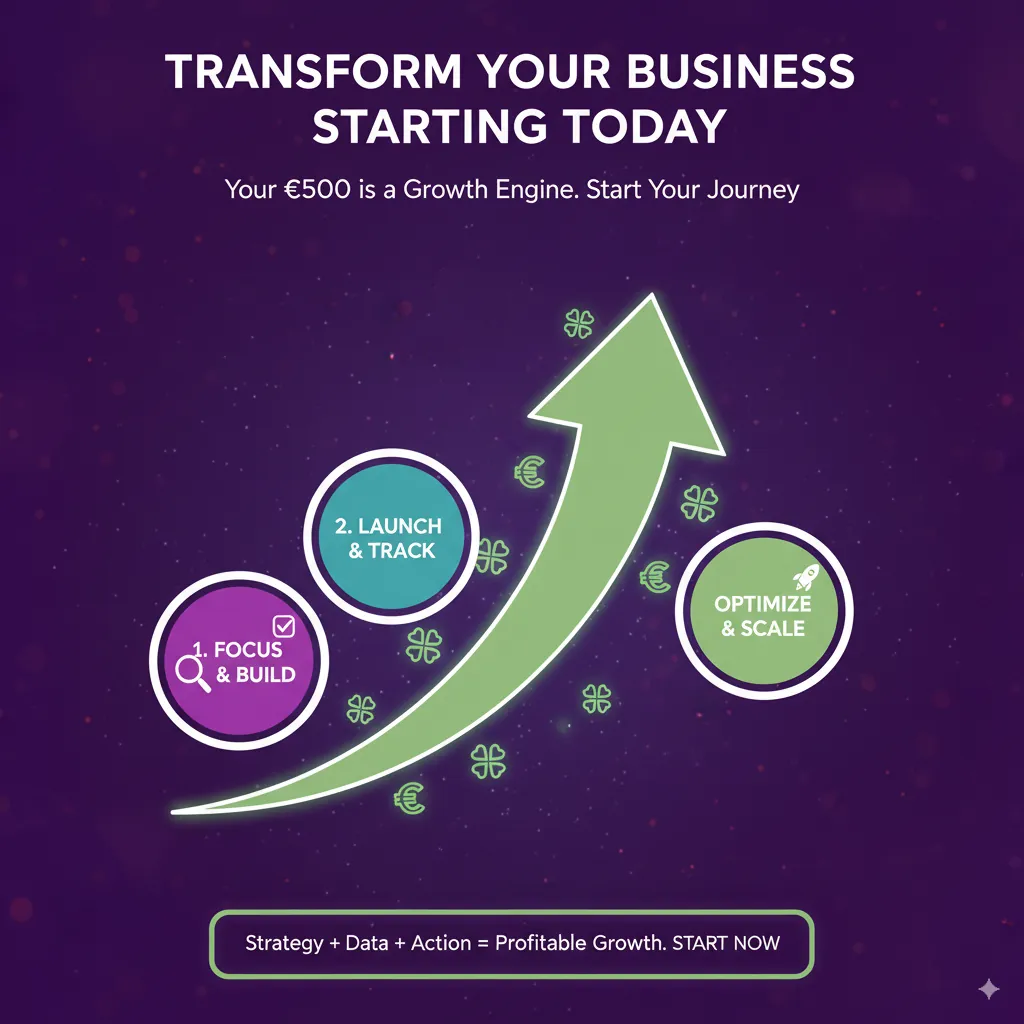
What to do with the first €500
Small business marketing works when a small budget is spent in one place.
None of this depends on having a big budget. It depends on choosing one channel, one offer and one number to judge it by, then leaving it alone long enough to produce data worth reading.
Where to start: Choose one primary marketing goal that aligns with immediate business needs. Identify the advertising channel where your customers already search and make purchase decisions. Create one compelling offer that addresses their specific needs and concerns with urgency and value. Launch your campaign with proper tracking systems that connect advertising spend to actual revenue. Measure real business outcomes rather than vanity metrics that don’t impact your bottom line. Scale successful elements while eliminating ineffective approaches that waste money.
When you get to the reinvest-in-search step, our guide to how much SEO costs in Ireland shows what a realistic monthly budget is for a small business and what it should buy.
Tell us your trade and your county, and we will talk through which channel suits your budget. No obligation.