



Should I focus on GEO or SEO?
Two acronyms turn up in every marketing conversation now, SEO and GEO.
They share a goal, being found by the people looking for you, and they go about it in completely different ways.
Understanding SEO
Search Engine Optimisation (SEO) is the practice of improving a site’s visibility in traditional search engines like Google and Bing, aiming to rank higher in organic results and earn clicks. When users type queries into search engines, SEO determines which websites appear at the top of the results pages.
This discipline has existed since the mid-1990s. It’s evolved dramatically alongside search engine algorithms.
SEO’s main goal is to win positions in search engine results pages (SERPs) and drive measurable traffic, conversions, and revenue from those clicks. The strategy encompasses multiple technical and creative elements, including keyword research, content optimisation, link building, technical website improvements, and user experience enhancements.
Google handles an enormous number of searches every day, which is why SEO still matters to any business that wants to be found. Effective SEO strategies still pay off.
SEO leans on keywords, backlinks, crawlable site structure, meta tags, internal links, and page performance. Search crawlers broadly index pages and use many ranking signals to determine rankings.
Google’s algorithm weighs many ranking signals when evaluating websites, and they change without notice.

What GEO, Generative Engine Optimisation, Means
Generative Engine Optimisation (GEO) represents something completely new. This concept emerged alongside artificial intelligence-powered search experiences and large language models. GEO focuses on making content easy for generative AI systems (ChatGPT, Gemini, Copilot, Google AI Overviews, and others) to understand, select, and cite inside AI-generated answers.
Unlike traditional search engines that provide lists of links, generative engines synthesise information from multiple sources to create direct answers. GEO’s goal is to be included or cited in AI-produced summaries and recommendations, where the user may see only one synthesised answer instead of a list of links.
This emerging field acknowledges a fundamental shift in how people access information online. Rather than clicking through multiple websites, users increasingly receive immediate answers from AI-powered tools that aggregate and summarise information.
It is faster for the person asking, and it changes where a business has to appear.
GEO involves structuring content so that AI models can easily understand, extract, and cite it when generating responses to user queries.
Key Differences in Approach
The fundamental distinction between SEO and GEO lies in their target platforms and optimisation methods. SEO targets traditional search engine crawlers and algorithms, whilst GEO focuses on AI language models and their training data.
SEO is historically built around short keywords and phrases. Terms like “SEO agency Dublin” or “ecommerce SEO” match with on-page content. Practitioners concentrate on signals like backlinks, keyword density, meta descriptions, and page load speeds to help search engines index and rank content effectively.
GEO emphasises clear question and answer formatting, strong factual accuracy, clean headings, and entity clarity so models can confidently extract specific facts or opinions.
GEO aligns with full, conversational prompts. Questions like “What’s the best SEO agency in Dublin for small businesses?” require context, nuance, and well-structured supporting evidence. AI needs to understand not just what you’re saying, but the intent behind it.
Content Strategy Variations

SEO content strategy traditionally revolves around keyword targeting. Marketers identify specific search terms their audience uses, then create content optimised for those phrases. This often involves balancing keyword placement with natural language to satisfy both search algorithms and human readers.
GEO content strategy prioritises comprehensive, authoritative answers to questions. Rather than focusing solely on keyword placement, GEO demands depth, accuracy, and proper sourcing. Content must serve as a reliable reference that AI models can confidently use when generating responses.
This includes FAQ sections, clear headings, and plain answers that AI systems can easily parse and extract. You’re essentially creating content that machines trust enough to recommend.
Technical Implementation Differences
SEO implementation involves numerous technical considerations.
Website architecture, XML sitemaps, robots.txt files, canonical tags, and structured data markup all influence search engine performance. Web design and development decide how SEO-friendly a website can be. Mobile responsiveness and page speed directly impact rankings, with Google confirming that page experience forms part of its ranking algorithm.
Slow pages lose visitors, which is why technical SEO and reliable web hosting matter.
GEO technical implementation focuses on content that AI can easily parse. Google says no special schema.org markup is needed to appear in AI Overviews.
Clear information hierarchy and API accessibility become paramount. Content must exist in formats that language models can readily access and understand during their training processes or real-time information retrieval.
Metrics and Measurement

SEO success metrics are well-established and quantifiable.
SEO performance is tracked via impressions, rankings, organic sessions, click-through rate, bounce rate, and conversions. These are usually measured in analytics and search console tools. Professionals use Google Analytics, Google Search Console and third-party tools to read performance in detail.
Ranking high still matters. Understanding SEO pricing and investment returns helps businesses budget effectively for their optimisation efforts.
GEO success is gauged differently. How often is your brand or page mentioned or cited in AI answers? What’s your visibility inside AI overviews? What’s your qualitative presence in conversational AI tools?
Metrics to track GEO visibility alongside SEO traffic include citation frequency in AI responses, brand mentions in generative summaries, and comparative analysis of which competitors appear in AI-generated answers. Currently, these measurements have less standardised reporting than traditional SEO metrics. This makes tracking more challenging but increasingly important as AI adoption grows.
User Intent and Behaviour
SEO caters to users who actively search for information using specific queries. These users typically expect to visit websites, browse content, and make their own judgements about credibility and relevance.
Traditional search takes several clicks and comparisons before anyone decides.
Despite questions like “is SEO dead,” SEO isn’t going anywhere soon.
GEO addresses users seeking immediate, synthesised answers without navigating multiple websites.
These users prefer conversational interfaces and trust the AI to aggregate reliable information. This represents a significant behavioural shift in information consumption, where users ask complete questions rather than typing fragmented keywords. They want answers, not links.
The Relationship Between GEO and SEO
GEO does not replace SEO.
Strong SEO makes it more likely that content is discovered and used as a source by AI systems, so the two work best as a combined “dual optimisation” strategy.
Link building forms a cornerstone of SEO strategy. Earning backlinks from reputable websites signals authority and relevance to search engines. The quantity and quality of inbound links substantially influence search rankings.
Effective link building strategies require time, effort, and expertise. There are no shortcuts.
For startups and smaller businesses, link building for startups is how authority gets built from scratch. That authority feeds both traditional search rankings and the chance of an AI system citing you as a credible source.
An effective long-term strategy usually means maintaining technical and content SEO best practices, then layering GEO tactics on top. QA sections, clear entities, and authoritative sourcing help you win both clicks and AI citations.

Long-Term Strategic Considerations
SEO is a mature discipline with established best practices. Businesses can reasonably expect consistent organic traffic growth through sustained SEO efforts.
Algorithm updates still disrupt rankings, so the work never quite stops.
GEO exists in a more experimental phase.
As AI technologies evolve rapidly, optimisation strategies must adapt accordingly. Early adopters may gain an advantage, but none of it is settled yet. Steps to audit existing content for GEO readiness include reviewing content for clear question-answer formatting, evaluating factual accuracy and sourcing, and assessing whether content addresses conversational queries.
Integration with Broader Marketing Strategies
Modern digital marketing requires an integrated approach.
SEO and GEO work alongside other channels including pay-per-click marketing, social media marketing, and email marketing to create comprehensive campaigns.
Platforms like Google Ads and Facebook Ads provide immediate visibility whilst SEO and GEO strategies build long-term organic presence. Understanding how much Instagram ads cost alongside organic strategy investments helps businesses allocate budgets effectively.
Local SEO and GEO Considerations
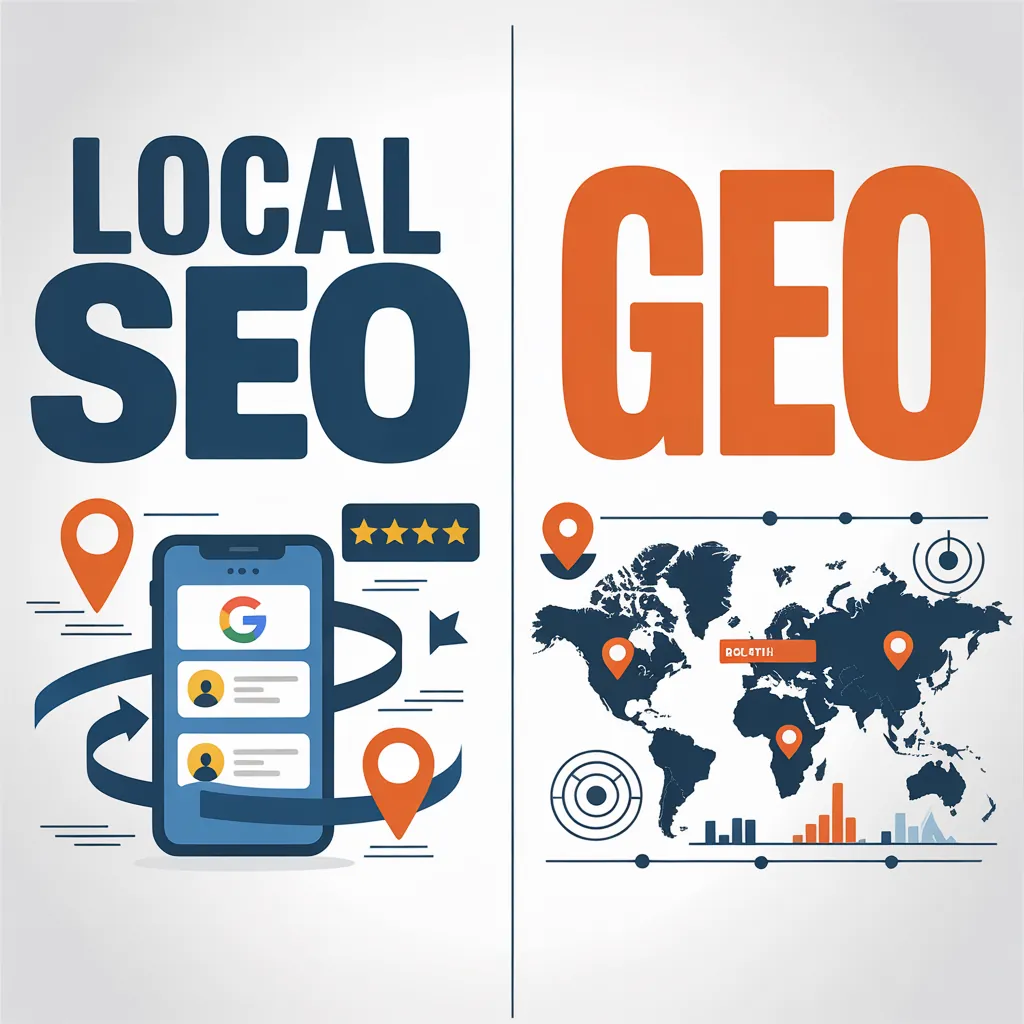
For businesses serving specific geographic areas, local SEO remains critically important.
Whether operating in Dublin, Cork, Galway, or Limerick, optimising for local search ensures businesses appear when customers search for nearby services. Local visibility drives foot traffic and phone calls.
Local GEO optimisation remains largely unexplored but will likely grow in importance as AI assistants provide location-based recommendations.
Small business advertising strategies must consider both traditional local SEO and emerging GEO opportunities.
E-commerce Specific Strategies
Online retailers face unique optimisation challenges requiring specialised approaches.
E-commerce SEO focuses on product pages, category structures, technical performance, and user experience elements specific to online shopping platforms. Product descriptions, image optimisation and site speed do most of the work.
E-commerce GEO presents intriguing possibilities as AI assistants increasingly help users discover and compare products.
Optimising product information for AI comprehension through detailed specifications and clear benefit statements could provide competitive advantages in this evolving landscape.
Optimising Blog Content for GEO
Understanding how to optimise a blog post for GEO citations requires a strategic approach.
Begin by structuring content with clear, descriptive headings that directly answer common questions. Include FAQ sections that address specific queries users might ask AI systems.
Ensure factual accuracy with proper citations and authoritative sources that AI systems can verify. Use entity-rich language that clearly identifies people, places, organisations, and concepts.
Create comprehensive content that thoroughly addresses topics rather than surface-level overviews, as AI models favour depth and authority when selecting sources to cite.
Complementary Strategies
SEO and GEO are not competing approaches.
Content that performs well in traditional search often meets the quality standards AI models seek. Authoritative, well-structured content serves both purposes effectively.
Many fundamental content principles apply universally: understanding audience needs, providing valuable information, ensuring factual accuracy, and maintaining readability.
These elements benefit both SEO and GEO performance. Professional graphic design and video production enhance content appeal across all platforms.
Future Outlook
The way people find things keeps changing.
Search behaviour shifts, with younger demographics increasingly turning to social media platforms and AI tools for information discovery. Traditional search engines adapt by incorporating AI-generated results, blurring the lines between SEO and GEO.
A business now has to be findable in more than one place.
Content has to satisfy traditional search algorithms and still be usable by AI systems, which means the two jobs are turning into one.
What to Do With Both
SEO focuses on optimising content for traditional search engines through technical improvements, keyword targeting, and link building. GEO targets AI-powered platforms by creating authoritative, well-structured content that generative systems can confidently cite.
The same page has to work for a human reader, a search crawler and a language model.
Frequently Asked Questions
What is the main difference between SEO and GEO?
SEO (Search Engine Optimisation) focuses on improving website visibility in traditional search engines like Google and Bing to rank higher and drive clicks. GEO (Generative Engine Optimisation) focuses on making content easy for AI systems like ChatGPT, Gemini, and Google AI Overviews to understand, select, and cite in AI-generated answers. They target different systems with different goals.
Does GEO replace SEO?
No, GEO does not replace SEO. Strong SEO makes it more likely that content is discovered and used as a source by AI systems. The two strategies work best as a combined “dual optimisation” approach, where you maintain technical and content SEO best practices whilst layering GEO tactics on top.
How do I measure GEO success?
GEO success is measured by tracking how often your brand or page is mentioned or cited in AI answers, your visibility inside AI overviews, and your qualitative presence in conversational AI tools. Metrics include citation frequency in AI responses, brand mentions in generative summaries, and comparative analysis against competitors in AI-generated answers. It’s less standardised than SEO measurement but equally important.
How can I optimise my blog posts for GEO citations?
To optimise blog posts for GEO, structure content with clear headings that answer common questions, include FAQ sections addressing specific queries, ensure factual accuracy with proper citations, use entity-rich language, and create comprehensive content that thoroughly addresses topics rather than providing surface-level overviews. Depth and authority win citations.
What are the steps to audit content for GEO readiness?
Audit your content for GEO by reviewing it for clear question-answer formatting, evaluating factual accuracy and source citations, assessing whether content addresses conversational queries, examining entity clarity (people, places, organisations), and determining if content provides comprehensive, authoritative information that AI models would confidently cite. Start with your most important pages first.
Can local businesses benefit from GEO?
Yes, local businesses can benefit significantly from GEO as AI assistants increasingly provide location-based recommendations. Optimising with consistent NAP (Name, Address, Phone) details, comprehensive location-specific content, and clear answers to local service queries positions businesses to be cited in AI responses for local searches.
How does content strategy differ between SEO and GEO?
SEO content strategy focuses on short keywords and phrases (like “SEO agency Dublin”) with keyword placement throughout the content. GEO content strategy aligns with full, conversational prompts (like “What’s the best SEO agency in Dublin for small businesses?”) requiring comprehensive answers, clear formatting, strong factual accuracy, and plain answers that AI systems can easily understand and extract. One targets crawlers, the other targets AI comprehension.
Tell us your trade and your county, and we will tell you how SEO and GEO apply to your business. Contact us to start. No obligation.