



Google Local Services Ads are the sponsored listings at the very top of Google for trades like plumbers, electricians and roofers. You don’t pay for clicks. You pay when a customer rings or messages you through the ad.
They run in both the UK and Ireland, and the last twelve months have changed more about them than any time since they launched here in 2020. The Google Guaranteed badge is gone. Lead disputes work differently in Europe. And Google is folding the whole product into Google Ads, with UK and Irish accounts moving in 2027.
Most guides you’ll find were written before any of that, and most were written for America. This one is built from Google’s own help pages, checked on 19 September 2026, for businesses in the UK and Ireland.
| At a glance | United Kingdom | Ireland |
|---|---|---|
| Available since | 2020 | 2020 |
| Trades covered | 28 home-service categories | 29 home-service categories |
| Solicitors and estate agents | Yes, Greater London only | No |
| Badge | Google Verified | Google Verified |
| Business registration accepted | Companies House number or VAT number | CRO number or VAT number |
| Automatic lead credits | Not available | Not available |
| Moves into Google Ads | 2027 | 2027 |
What are Google Local Services Ads?
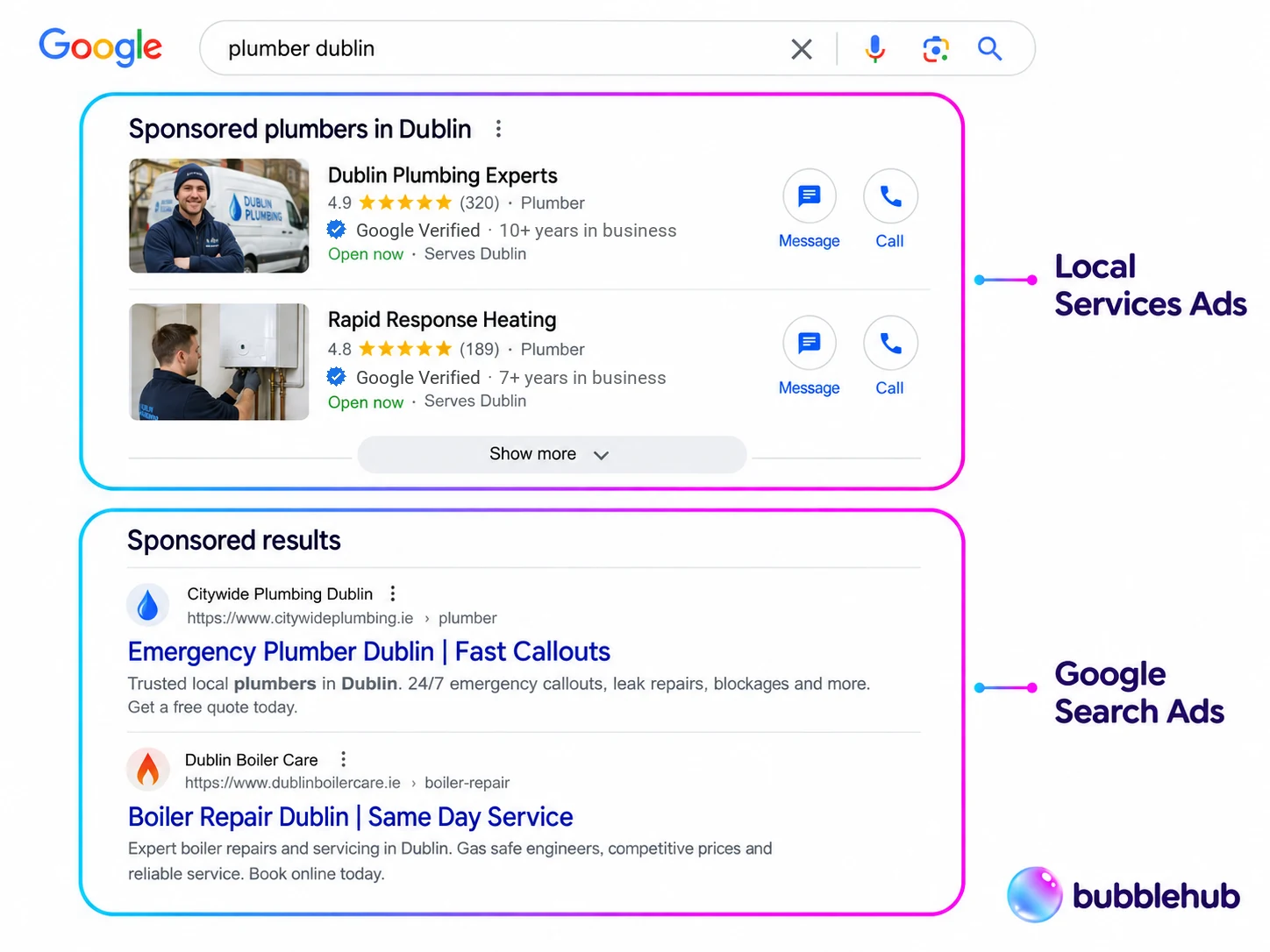
Local Services Ads, or LSAs, are a separate kind of Google ad made for local service businesses. When someone searches for a trade in an area you cover, Google can show your business in a sponsored unit at the top of the results, with your name, your star rating and a button to call or message you.
Here’s what that looks like on a phone in Ireland, searched on 19 September 2026.
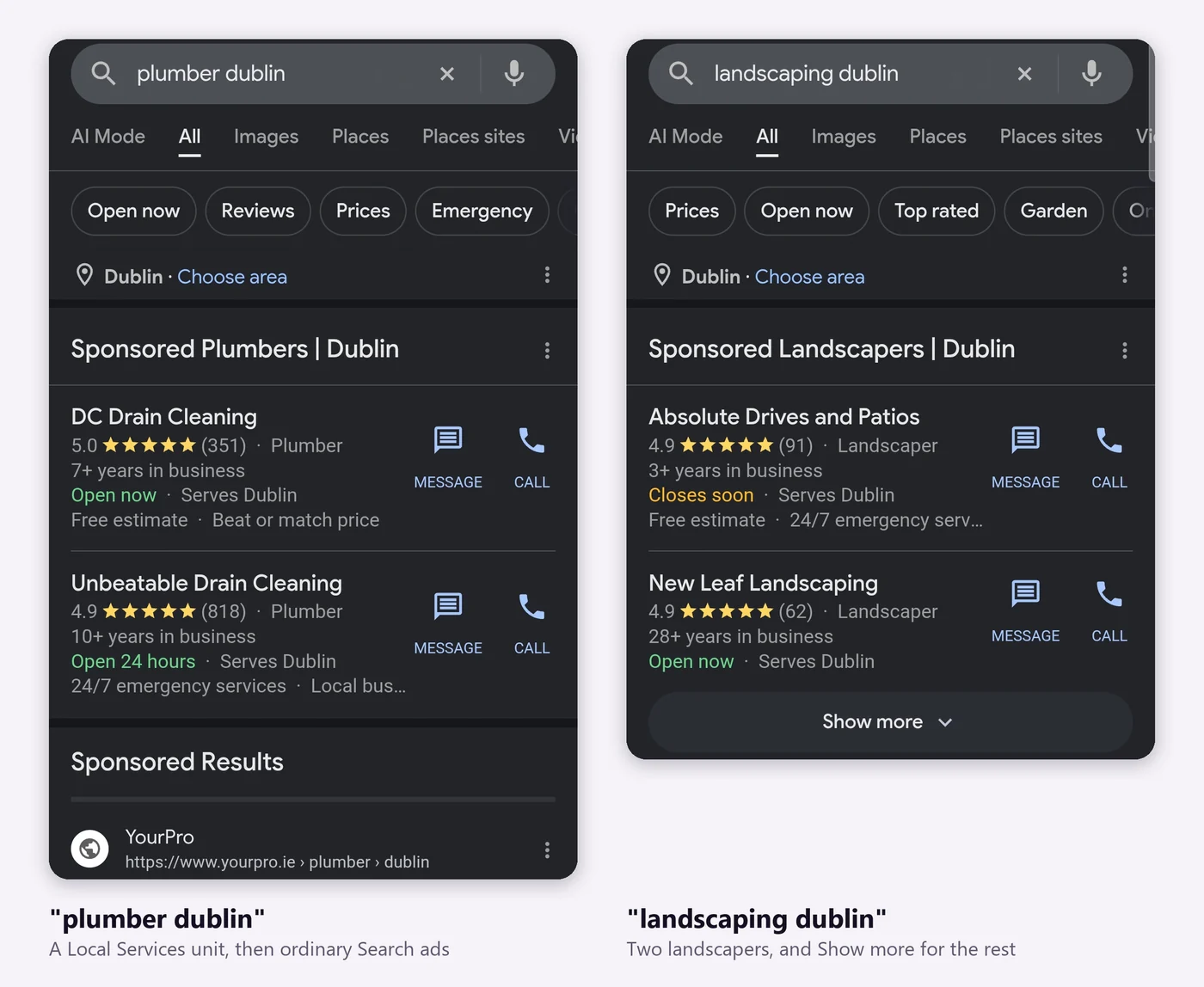
Each listing shows the rating and number of reviews, the trade, years in business, whether you’re open, the area you serve and a couple of short highlights you choose, like “Free estimate” or “24/7 emergency services”. The unit sits above the ordinary “Sponsored results”, which are standard Google Search ads.
Three things make them different from ordinary Google Ads.
- You pay per lead, not per click. A charge happens when someone contacts you through the ad, not when they look at it.
- There are no keywords. Google matches you to searches from the trade, the job types and the areas you choose.
- Google checks you first. Your registration, insurance and in some trades your licences are checked before you can earn the badge.
Google’s own illustration shows the same parts on a single card.
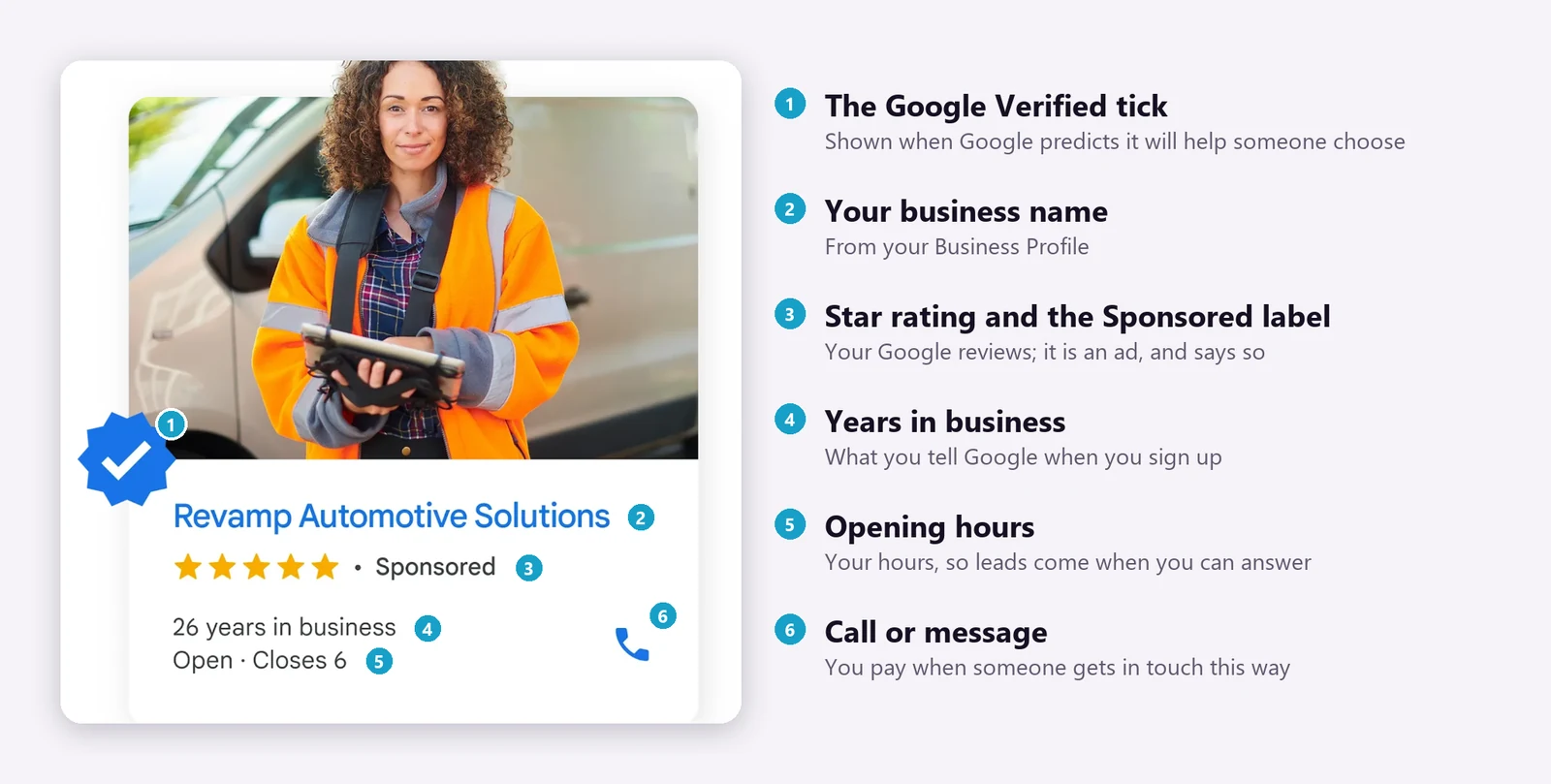
You don’t need a website to run them either. The ad links to a Google profile page built from what you enter and from your Business Profile, and leads come straight to your phone and inbox.
What happened to Google Local Services Ads?
They weren’t killed, whatever the YouTube thumbnails say. They changed, a lot, in a short space of time.
| When | What changed | Does it affect the UK and Ireland? |
|---|---|---|
| July 2024 | Manual lead disputes were replaced by automatic lead credits | No credits: Google doesn’t offer them to advertisers in Europe, the Middle East and Africa |
| January 2025 | The separate Local Services Ads app was retired | Yes |
| 20 October 2025 | Google Verified replaced Google Guaranteed, Google Screened and the money-back guarantee | Yes. The last guarantee claims closed on 7 December 2025 |
| 2026 | Pre-badge ads let a business take leads while it finishes verification | Yes, with some trades excluded |
| 2 August 2026 | AI-generated or AI-edited images banned from the ads in the EU | Ireland yes, the UK no |
| August 2026 | US accounts start moving into Google Ads as Performance Max campaigns with pay-per-lead goals | Not yet |
| 2027 | All accounts outside the US move into Google Ads | Yes, this is when UK and Irish accounts move |
So if you run LSAs in Dublin, Leeds or Birmingham, your ads, your dashboard and your pay-per-lead billing carry on as they are for now. Google will email your account’s administrator 14 days before your account moves, and again 7 days later.
What happened to Google Guaranteed and Google Screened?
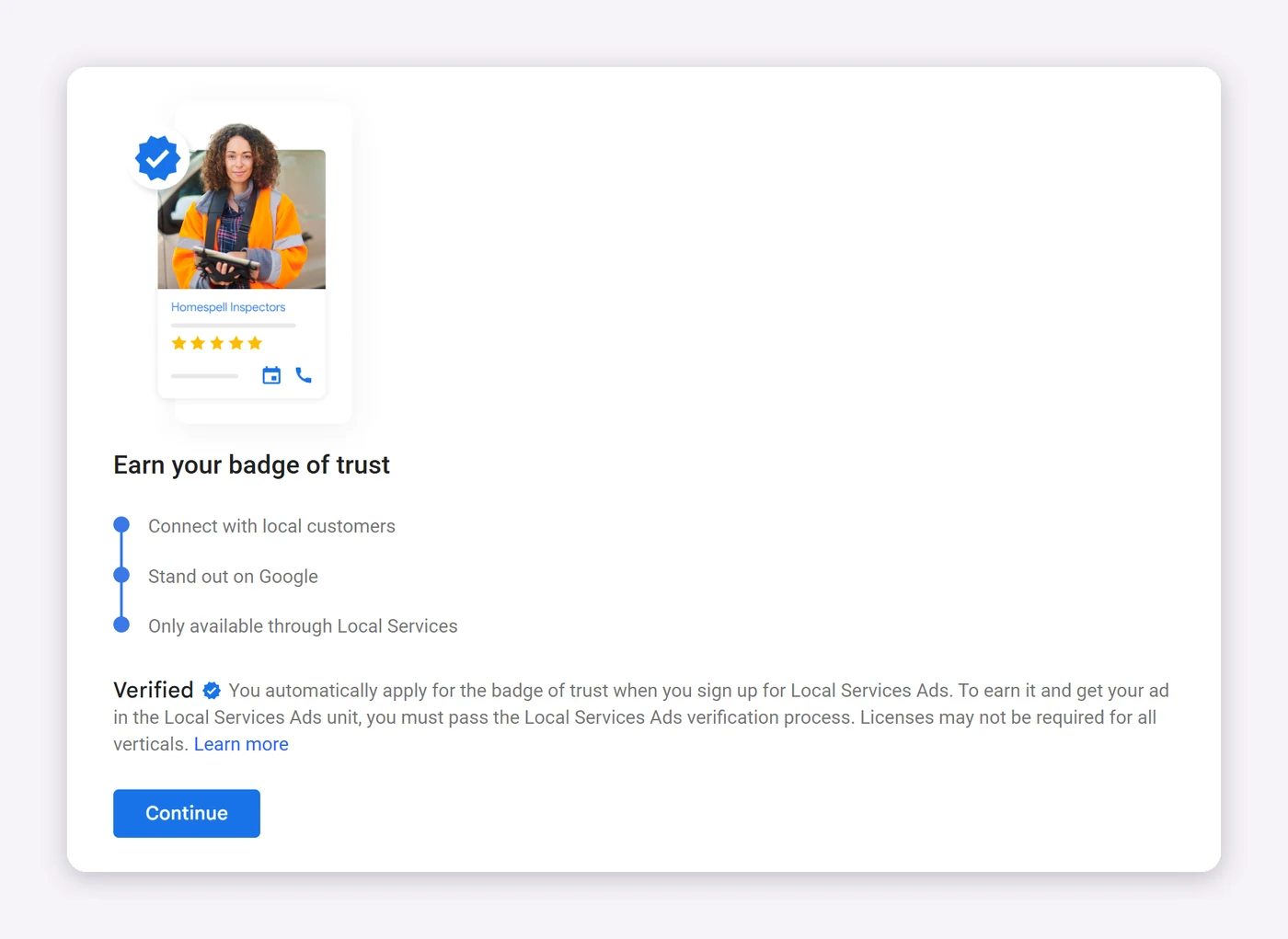
Google retired both on 20 October 2025. In their place is one badge, a blue tick called Google Verified, and alongside it Google lists the checks your business passed.
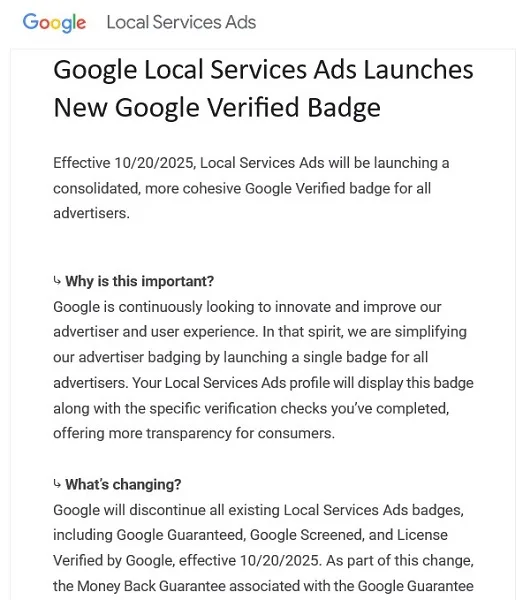
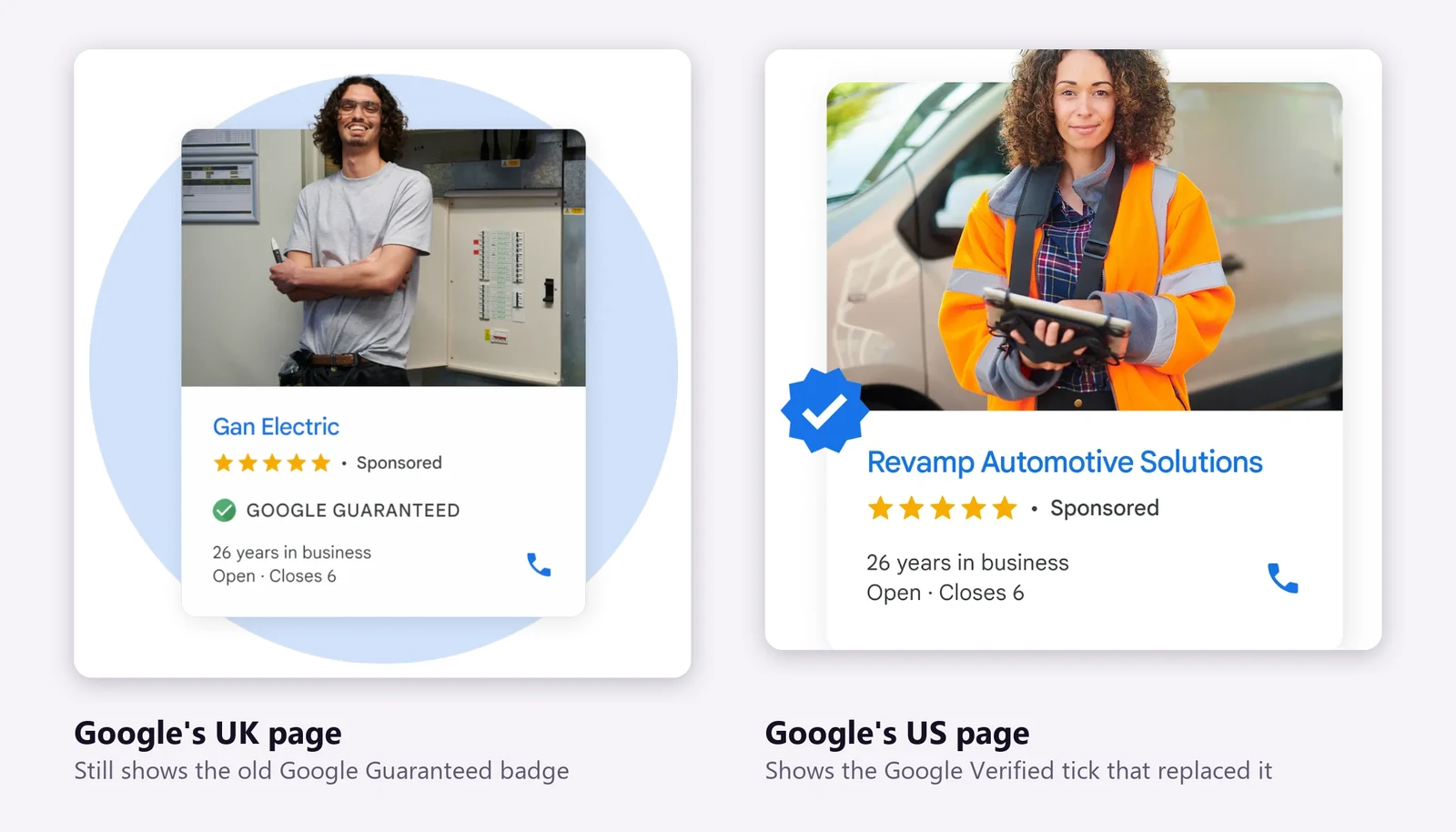
Not every page has caught up, Google’s own included.
The money-back guarantee went with them. Under Google Guaranteed, a customer in the UK could claim up to £1,500 over their lifetime, and in Ireland up to €1,500, if a job booked through the ad went wrong. Claims had to be in by 7 December 2025. There is no Google-backed refund now, whatever an older guide or an agency page tells you.
Two more details matter. Google doesn’t show the badge on every ad: it shows it when it predicts the badge will help someone choose. In the two Dublin searches above, neither unit showed it at all. And Google says the badge doesn’t change where you rank. It tells customers you’ve been checked, that’s all.
So when Google’s UK marketing page shows the old Guaranteed badge, as it still did in September 2026, don’t let it confuse you. The help pages and the sign-up screen both use Google Verified.
Are Local Services Ads available in the UK and Ireland?
Yes, in both. Google launched them in 10 European countries in 2020, the UK and Ireland among them, and today its help pages list 11 countries: Austria, Belgium, Canada, France, Germany, Ireland, Italy, Spain, Switzerland, the United Kingdom and the United States.
What differs is the list of trades. In the UK and Ireland it’s home services, with one professional pilot in London. In the US it’s far wider, covering health, beauty, cars, childcare and more.
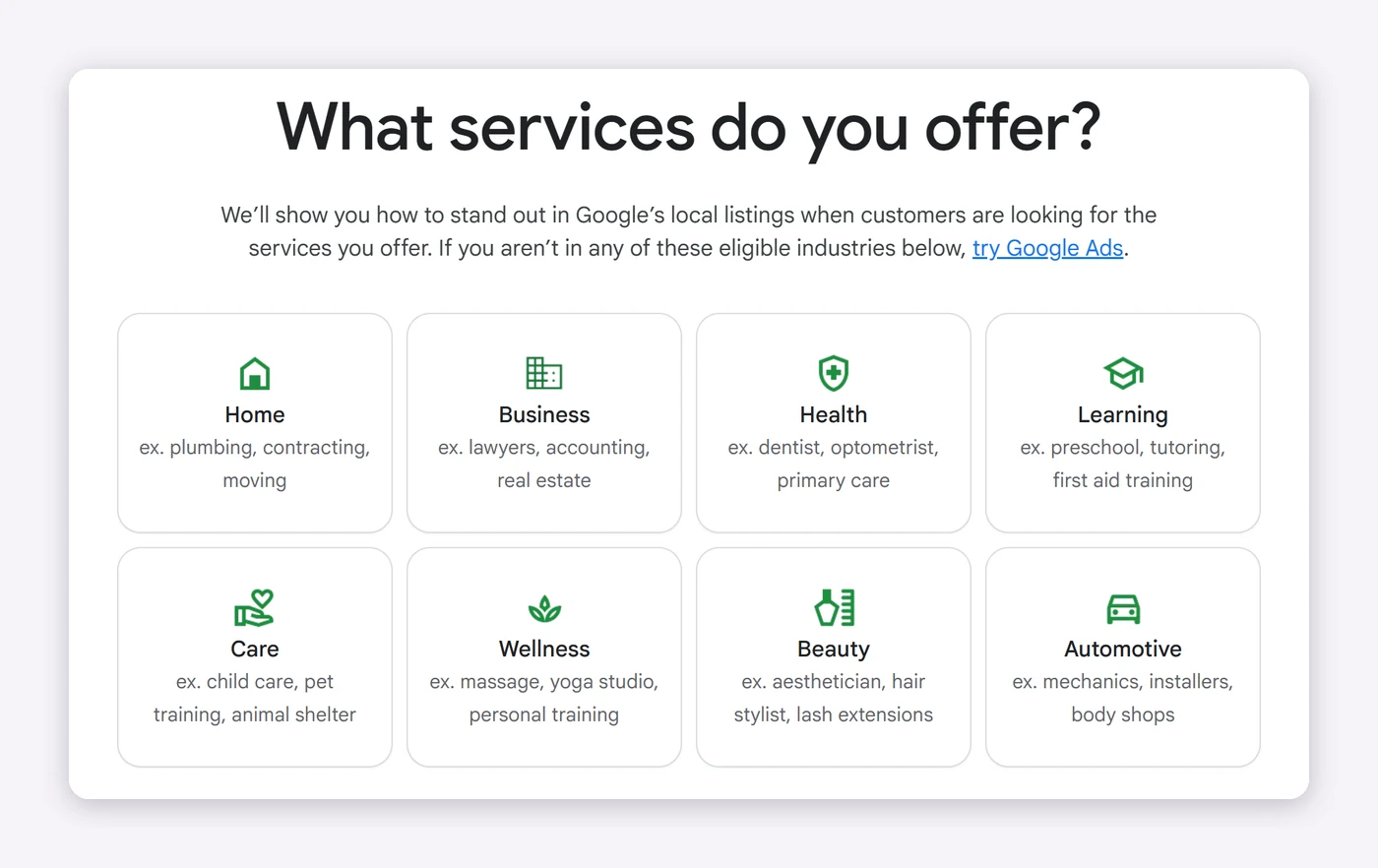
UK categories
Google lists these home services for Great Britain: appliance repair, carpenters, carpet cleaning, cleaning, worktops, electricians, fencing, flooring, foundations, garage doors, general contractors, handyman, home inspection, HVAC (heating and air conditioning), junk removal, landscaping, lawn care, moving services, pest control, plumbers, pool cleaning, pool contracting, roofers, snow removal, tree services, water damage, window cleaning and window repair.
Solicitors and estate agents can advertise too, but only in Greater London, as a pilot. The legal categories are contract, corporate, criminal, employment, family, immigration, insolvency, intellectual property, litigation, malpractice, personal injury, probate, property, road traffic and tax law, plus general lawyer services and estate agents. Google’s requirements page is blunt: outside Greater London, those ads won’t show.
Locksmiths, accountants and financial planners aren’t on the UK list. A boiler engineer fits under HVAC.
Ireland categories
Ireland has 29 home-service categories: the UK list with worktops called countertops, plus siding. There are no legal or professional categories, so a solicitor in Dublin can’t use Local Services Ads.
They’re live. The two searches at the top of this guide were made on a phone in Ireland, and both brought up a full Local Services unit.
Northern Ireland is the one question mark. Google’s pages don’t mention BT postcodes either way, so check your own postcode at sign-up rather than trusting anyone’s say-so, ours included.
What’s US-only
A few features you’ll read about in American guides don’t exist here. Booking leads, lead-credit tracking and review requests from the dashboard are US and Canada only, and so are the background checks on owners and staff. In Europe, Google checks the business itself: its registration, insurance and licences.
Where do Local Services Ads show up?
At the top of Google Search, above the ordinary ads and the map results, and on Google Maps. They appear on phones and computers.
Your ad can show when someone searches for your trade (“plumber near me”), for a job you’ve told Google you do (“boiler repair”), or for your trade in a place you cover (“electrician Navan”), and when the searcher is inside your service area. You can exclude postcodes you don’t want to serve.
One useful rule: when someone searches for your business by name, only your ad shows, and Google doesn’t charge you for a returning customer.
How much do Local Services Ads cost in the UK and Ireland?
You set a budget, and Google charges you for each lead, not each click. What a lead costs depends on your trade, your area, the type of lead and how you bid. Messages usually cost less than calls.
Google doesn’t publish a price list for the UK or Ireland. What’s out there comes from agencies, based on their own clients, not from a dataset:
- Virens, a UK agency, says most home-service leads cost £20 to £50.
- Peak Digital says anything from a few pounds to over £30.
- Big Gun Digital published one roofing client’s figures: £738.29 spent on 102 leads, 95 of them charged, about £7.77 each.
- Agile Digital Strategy quotes €15 to €60 a lead in Ireland.
Treat those as the range others have seen, not a quote. Your first month is the only real price list you’ll get.
How budgets and bidding work
You set a weekly budget. Google suggests enough for at least 10 leads a week, so it has room to learn. Then you choose how to bid:
- Maximise leads: Google gets you as many leads as it can within the budget.
- Target cost per lead: you tell Google the average you want to pay, and it aims for it.
- Maximum per lead: you set a ceiling for any single lead.
When your account moves into Google Ads in 2027, the weekly budget becomes a daily one (the weekly figure divided by 7), and your monthly spend is capped at 30.4 times that daily figure. The maximum-per-lead option goes, and so does setting a different target for each trade in one campaign.
A quick worked example, with made-up round numbers. A plumber who sets £200 a week and pays £25 a lead averages 8 leads a week. If 1 in 3 becomes a job worth £300, that’s about 2.7 jobs and £800 of work a week for £200 of ads. Swap in your own figures: what a lead costs you, how many you win, what a job is worth. Our Google Ads budget calculator does the same sum for ordinary Search ads.
VAT and the UK Digital Services Tax
Local Services Ads are billed through Google Ads. Irish accounts are charged Irish VAT. For UK business accounts, Google’s tax page lists Great Britain under Google Ireland Limited with no VAT added and the advertiser accounting for it, but the wording is written for the EU, so check the treatment with your accountant. Google also adds a 2% UK Digital Services Tax fee to ads served in the UK; its pages don’t say whether that applies to lead charges.
What counts as a lead, and what you pay for
A lead is a customer getting in touch through your ad: a phone call or a message. Calls come through a Google forwarding number, so Google can tell which calls came from the ad. Booking leads exist too, but only in the US and Canada.
From 1 October 2026 Google starts charging for some missed calls during your opening hours, when the caller stays on the line for more than 20 seconds. Google announced it alongside the US changes, and none of its pages we read say whether it covers the UK and Ireland. Either way, the fix is the same: answer the phone, or change your hours to the hours you actually answer it.
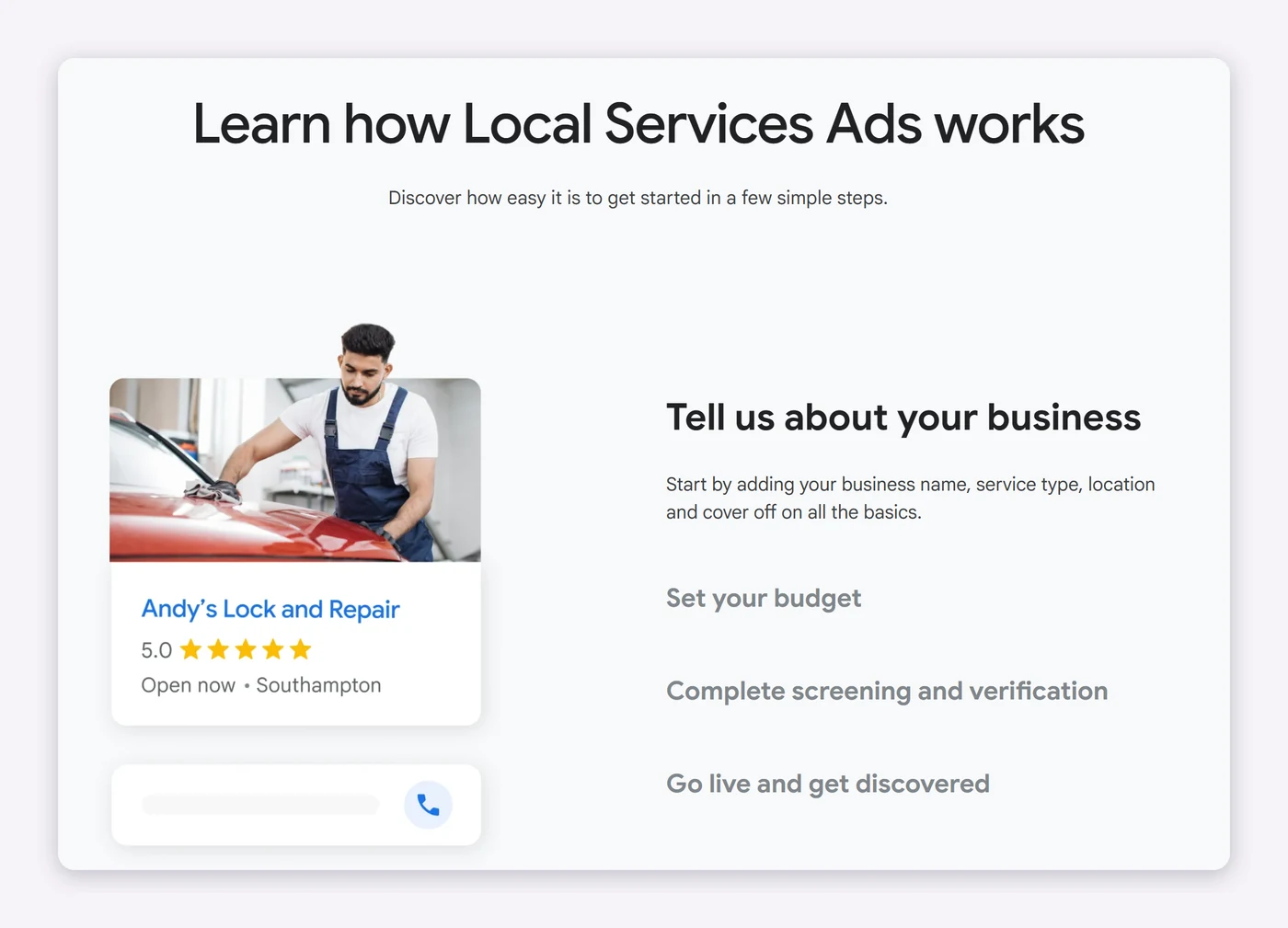
How to set up Local Services Ads, step by step
Setting up takes an afternoon. Verification takes longer, so start there.
- Get your Google Business Profile verified first. A public, verified profile is now required. Our guide to Google Business Profile verification covers every method.
- Check you’re eligible. Go to Google’s Local Services sign-up at ads.google.com/localservices/signup, sign in with the Google account you want to manage it from, and enter your trade and postcode.
- Add your business details. Name, phone number, years in business, and the service area, by postcode or distance.
- Pick your job types. Tick only the jobs you want. Every job type you leave on can bring a lead you pay for.
- Set your hours. The hours you’ll really answer the phone, not the hours on your door.
- Set your budget and bidding. As above. You can change both later.
- Upload your verification documents. See the next section.
- Set up billing and go live. With pre-badge ads, you may start getting leads before the badge comes through, shown below businesses that have it.
What documents you need
| What Google checks | UK | Ireland |
|---|---|---|
| Business registration | Companies House number or VAT number | CRO number or VAT number |
| Insurance, home services | Public liability, showing the amount covered | Public liability, showing the amount covered |
| Licences | Where the law requires one for your trade | Where the law requires one for your trade |
| Solicitors (London pilot) | Professional indemnity insurance and active regulator membership for every member of the firm | Not available |
| Estate agents (London pilot) | Professional indemnity insurance | Not available |
| Background checks on people | Not required | Not required |
Employer’s liability insurance doesn’t count. If your policy has no expiry date, Google wants proof you’ve paid for the last year. Google doesn’t publish minimum cover amounts; it shows them on the upload screen for your trade and area.
Google doesn’t promise a timescale for checks. UK agencies report anything from about a week to a month. Screening itself is free.
How do I log in to Local Services Ads?
Until your account moves, you manage it in the Local Services dashboard at ads.google.com/localservices, signed in with the Google account you set it up with. There’s no separate app any more; Google retired it in January 2025.
After the move in 2027, the old dashboard redirects to Google Ads. Your leads move with you, including messages and older call recordings. Your old performance reports don’t, so download or screenshot them before your date.
How are Local Services Ads ranked?
Google’s help pages name three things: your bid and budget, how likely your ad is to produce a lead, and the quality of your profile.
- Responsiveness. Answer calls and reply to messages. Google says businesses that regularly miss calls or ignore messages can lose ranking. Reply even when you’re turning a job down.
- Relevance. The job types and areas you’ve chosen, against what was searched and where.
- Reviews. Your rating and the number of reviews, the same ones as on your Business Profile.
- Profile quality. Photos, a proper business description, the checks you’ve passed.
One thing that isn’t on Google’s list, despite what you’ll read: the badge itself. Google says it doesn’t affect ranking. Google also shows only one location per business in the unit.
Reviews are the lever most businesses under-use. Our guide on how to get more Google reviews shows how to ask, within Google’s 2026 rules.
Can I dispute a bad lead in the UK or Ireland?
Not the way American guides describe. In July 2024 Google replaced manual disputes with automatic lead credits, and those credits aren’t available to advertisers in Europe, the Middle East and Africa. That covers the UK and Ireland.
What you can do is rate every lead in the lead feedback form, which Google says it uses to send you better ones, and tighten your settings. A stream of calls for jobs you don’t do usually means a job type is switched on that shouldn’t be, or your area is wider than you’d like. Change those first.
What changes when your account moves to Google Ads in 2027
Google’s help page on the move is clear on what stays the same: you still pay per lead, the ads still show only on Search and Maps, there are still no keywords, and your Google Verified badge carries over. You won’t need to re-verify insurance or licences.
Before your date, do four things:
- Download or screenshot your performance reports. They don’t move across.
- Note your budget as a weekly figure, and work out the daily one (divided by 7).
- If you use a maximum per lead, decide on a target cost per lead instead.
- If you run several trades with different targets, plan a separate campaign for each; Google Ads can’t hold different targets for different trades in one.
Your business name, address and hours will sync one way from your Business Profile, so make sure it’s right. A big change to your name or address triggers a review that Google says usually takes 24 to 48 hours.
Local Services Ads vs Google Ads, which should you use?
| Local Services Ads | Google Search ads | Performance Max | |
|---|---|---|---|
| You pay for | Leads (calls and messages) | Clicks | Clicks |
| Where it shows | Top of Search and Maps | Search results | Search, Maps, YouTube, Gmail, Display |
| Keywords | None | You choose them | None; Google decides |
| Checks on your business | Registration, insurance, licences | Advertiser identity only | Advertiser identity only |
| Who can use it | Listed trades only | Any business | Any business |
| Needs a website | No | Usually | Usually |
| Best for | Urgent, local, phone-first jobs | Planned jobs, research, anything off the LSA list | Wider reach once the basics work |
If your trade is on the list, LSAs are usually where to start: they sit higher, they’re simpler, and a bad week costs you leads, not clicks from people who never rang. Search ads earn their place alongside them for jobs people research before they pick up the phone, and for any service that isn’t on Google’s list.
Google’s own advice is to run both where it fits: LSAs for the customer who wants someone now, Search ads for the one still comparing. Our guide to what Google Ads costs in Ireland covers the Search side.
How to get more leads from Local Services Ads
Answer the phone. It’s the single biggest thing, because Google ranks you on it and charges you for leads either way. If you can’t answer during the day, shorten your hours to the ones you can, or use call handling that picks up in your name.
Keep your job types tight and your area honest. Every job type switched on is a lead you might pay for, so switch off the jobs you’d turn down.
Get reviews steadily. They feed the rating on your ad, and a trickle from real customers beats a burst from friends, which Google’s filters can remove.
Fill in the profile properly: real photos of real jobs, a clear description, your years in business. And in Ireland, don’t upload AI-generated or AI-edited images; since August 2026 they’re banned from the ads in the EU.
Are Google Local Services Ads worth it?
For a trade on Google’s list, usually yes, with one condition: you have to be able to take the calls.
They suit a business that sells jobs by phone, covers a clear area and has a steady stream of reviews. They suit less well a business that can’t answer during the day, wants to pick and choose jobs, or sells work people research for weeks before they ring. For those, Search ads and a strong website often work harder.
Compared with the directories, the difference is who pays and for what. On Checkatrade, MyBuilder or Bark you pay the platform for membership or for introductions. With LSAs you pay Google for a customer who searched, chose you, and contacted you directly.
How do I turn off Local Services Ads?
To stop leads for a while, pause your ad in the Local Services dashboard. You can switch it back on at any time, and your profile and badge stay in place. After the move to Google Ads, you pause the campaign in its settings.
If Google Ads is taking money you didn’t expect, check the Google Ads account linked to your Local Services profile. Local Services Ads are billed through Google Ads, so that’s where the charges come from.
Other questions people ask about Local Services Ads
What does LSA stand for?
Local Services Ads, Google’s pay-per-lead ads for local service businesses.
Do I need a website for Local Services Ads?
No. The ad links to a Google profile page and leads come by phone and message. A website still helps customers who want to check you out before they ring.
Do I need a Google Business Profile?
Yes. A public, verified Business Profile is now required, and its reviews are the ones shown on your ad.
Can solicitors use Local Services Ads?
In the UK, yes, but only in Greater London, as a pilot. In Ireland, no: Google offers only home-service categories there.
Do Local Services Ads show on Google Maps?
Yes. Google says they show on Search and Maps, and that stays the same after the move to Google Ads.
Do Local Services Ads help SEO?
Not directly. They’re paid placements and don’t change your organic or map rankings. They do share your reviews with your Business Profile, and reviews help both.
How long does Local Services Ads verification take?
Google doesn’t commit to a timescale. UK agencies report anything from about a week to a month after you upload your documents. Pre-badge ads can bring leads in the meantime in most trades.
Are background checks needed in the UK or Ireland?
No. Google runs background checks on people only in the US and Canada. In Europe it checks the business: registration, insurance and licences.
Is the Google Guarantee still available?
No. It ended with the switch to Google Verified in October 2025, and the last claims closed on 7 December 2025.
If you’d rather someone ran it for you
Setting LSAs up is straightforward. Running them well is mostly unglamorous: checking every lead, trimming job types, chasing reviews, and making sure the phone gets answered. That’s the part we do for trades across Ireland and the UK, alongside their Google Ads and their Business Profile.
Sources
Every rule in this guide comes from Google’s own pages, checked on 19 September 2026. Google changes this product often, and we’ll keep this page up to date.
- Getting started with Local Services Ads, United Kingdom and the Ireland version
- Business screening and verification requirements
- About ad rankings
- Automated Local Services Ads lead credits
- Local Services Ads moving to Google Ads
- Google Verified, Google Ads blog, 20 August 2025
Agency cost figures are named where they appear and are theirs, not ours.