



If a patient in your town searches for a dentist on Google and cannot find you, they find a competitor instead. That is what Dental Search Engine Optimisation (SEO) is for. We do this work for dental practices as an SEO agency in Ireland.
There is more on Irish SEO on the Bubble Blog.
1. Why Every Irish Dentist Needs SEO
Whether you run a general clinic in Cork or a specialist implant centre in Dublin, patients find you the same way. Five reasons SEO matters to a dental practice.
- Be Found Where Patients Are Looking: When someone in Galway needs an “emergency dentist” or is researching “dental implants cost Limerick,” their first stop is almost always Google. If your practice isn’t visible on the first page of search results, you’re essentially invisible to a vast pool of potential patients. Effective Dental SEO ensures your services are easily found by those actively seeking them.
- Attract High-Intent Patients: Dental SEO isn’t about casting a wide, indiscriminate net. It’s about attracting individuals who are specifically searching for the dental services you offer in your locality. This means higher quality leads and a greater likelihood of converting searchers into booked appointments.
- Build Trust and Credibility: Practices ranking highly on Google are often perceived as more established, trustworthy, and authoritative. A strong SEO presence, coupled with positive patient testimonials (which SEO helps showcase), builds credibility before a patient even steps into your clinic.
- Achieve Cost-Effective, Long-Term Growth: Compared to ongoing costs for paid advertising (like Google Ads or traditional print), organic SEO offers a superior long-term return on investment. Once you achieve high rankings for valuable keywords, you continue to attract patients without paying for every click, generating a consistent new patient pipeline.
- Gain a Competitive Edge: In the competitive Irish dental market, a well-executed SEO strategy can be the differentiator that puts you ahead of other local practices.
2. What Makes Dental SEO Unique from General SEO Services?
While the core principles of SEO apply across industries, Dental SEO has distinct nuances:
- Hyper-Local Focus: Unlike e-commerce businesses aiming for national or international reach, dental practices primarily serve local communities. Therefore, Dental SEO heavily emphasises Local SEO tactics, targeting patients in specific cities (e.g. “family dentist Waterford”) or even neighbourhoods. The immediacy of need (e.g. “emergency dentist near me”) is also a key factor.
- Trust and Authority are Paramount: Patients are making decisions about their health. SEO for dentists must build trust through high-quality, informative content, showcasing expertise, patient reviews, and transparent practice information.
- Educational Content is Key: Potential patients often research conditions and treatments (crowns, veneers, orthodontics) before committing. Dental SEO involves creating educational content that answers their questions, alleviates concerns, and gently guides them towards booking a consultation. Patient education and local targeting together are what make dental SEO work.
- Regulation and Compliance: Dental marketing must adhere to specific advertising standards and ethical guidelines, which an experienced dental SEO provider will understand.
3. Local SEO for Attracting Nearby Patients
Local SEO is the cornerstone of attracting patients from your immediate geographical area. Here’s how local SEO affects your search rankings for Irish dental practices:
- Geo-Specific Keyword Optimisation: Optimise your website pages and content with location-specific keywords. This means incorporating terms like “teeth whitening Dublin 4,” “children’s dentist Cork City,” or “orthodontist near [your specific suburb].”
- Google Business Profile (GBP): Your GBP listing is the single biggest Local SEO asset you have.
- Local Citations (NAP Consistency): Ensure your practice’s Name, Address, and Phone number (NAP) are consistent and accurate across all online directories (e.g. Yelp, GoldenPages.ie, WhatClinic.com, local business associations). Inconsistencies can confuse search engines and harm your rankings.
- Online Reviews Management: Encourage satisfied patients to leave positive reviews on your GBP listing and other relevant platforms. Respond professionally to all reviews, both positive and negative. Reviews are a significant local ranking factor and heavily influence patient decisions.
- Local Link Building: Acquire backlinks from other local businesses, community organisations, or relevant Irish healthcare sites. This signals local relevance to search engines.

4. Finding the Keywords Your Patients Actually Search For
Effective keyword research is foundational. You need to understand the exact phrases your potential Irish patients are typing into Google.
- Identify Core Services & Treatments: Start by listing all services you offer (e.g. general check-ups, dental implants, Invisalign, emergency care, cosmetic dentistry).
- Add Location Modifiers: Combine your services with your city, county, and even specific districts (e.g. “Invisalign provider Galway,” “emergency dentist Dublin South”).
- Consider Patient Intent:
- Informational Keywords: “how much do dental implants cost in Ireland,” “signs of gum disease.” (Attracts users seeking information, good for blog content).
- Transactional/Commercial Keywords: “book dentist appointment Cork,” “best orthodontist Limerick.” (Users ready to book, so these belong on service pages).
- Long-Tail Keywords: These are longer, more specific phrases (e.g. “affordable family dentist near Stillorgan”). They often have lower search volume but higher conversion rates.
- Utilise Keyword Research Tools:
- Google Keyword Planner: A free tool from Google (requires a Google Ads account).
- Paid SEO Tools: Ahrefs, SEMrush and Moz Keyword Explorer go into more detail.
- Google Search Itself: Look at “People Also Ask” boxes and “Related searches” for ideas.
- Analyse Competitors: See what keywords your top-ranking local competitors are targeting (but aim to find your unique opportunities too).
- Avoid Keyword Stuffing: Integrate keywords naturally into high-quality content. Over-optimisation can lead to penalties and a poor user experience.
5. Technical SEO Essentials for a High-Performing Dental Website
Technical SEO makes your website easy to crawl, easy to index and easy to use, and all three decide whether you rank. Professional web design and development is where that starts.
- Website Speed: A slow-loading website frustrates users and hurts rankings. Aim for a load time of under 3 seconds. Compress images, turn on browser caching, and minify code. Use Google PageSpeed Insights to test and get recommendations.
- Mobile-Friendliness (Responsive Design): The majority of local searches happen on mobile devices. Your website must provide an excellent experience on all screen sizes. Google uses mobile-first indexing, meaning it primarily considers the mobile version of your site for ranking.
- Secure Website (HTTPS): An SSL certificate (HTTPS) encrypts data between the user’s browser and your server. It’s a confirmed ranking factor and it matters for patient trust, especially when someone is submitting a contact form.
- Clear Website Architecture & Navigation: A logical site structure makes it easy for users and search engines to find content. Use clear menus and an intuitive hierarchy.
- XML Sitemap: An XML sitemap lists all important pages on your website, helping search engines discover and index them efficiently. Submit it via Google Search Console.
- Robots.txt File: This file tells search engine crawlers which pages or sections of your site they should or shouldn’t crawl.
- Clean URL Structure: Use short, descriptive URLs that include relevant keywords (e.g. yourdentalpractice.ie/services/teeth-whitening-dublin).
- Structured Data Markup (Schema): Implement schema markup (e.g. for Dentist, LocalBusiness, Review, FAQPage) to provide search engines with more context about your content. This can lead to rich snippets in search results (e.g. star ratings, FAQ dropdowns).

6. On-Page SEO for Your Website Content
On-page SEO involves optimising individual pages on your website to rank higher and earn more relevant traffic.
- Compelling Page Titles (Title Tags):
- Craft unique, descriptive titles for each page (under 60 characters).
- Include your primary keyword and location (e.g. “Expert Dental Implants in Cork | [Your Practice Name]”).
- Make it click-worthy for users in search results.
- Engaging Meta Descriptions:
- Write unique meta descriptions for each page (around 155-160 characters).
- Think of it as an “ad” for your page. Include keywords and a call-to-action.
- Example: “Looking for trusted dental implant specialists in Cork? [Your Practice Name] offers advanced solutions. Book your consultation today!”
- Header Tags (H1-H6):
- Use one H1 tag per page for the main title, incorporating the primary keyword.
- Use H2s for main subheadings, H3s for sub-subheadings, etc. incorporating related keywords. This structures content logically for users and search engines.
- High-Quality, Keyword-Rich Content:
- Create informative, engaging, and original content that addresses patient needs and questions.
- Naturally integrate your target keywords and related LSI (Latent Semantic Indexing) terms throughout the text.
- Aim for comprehensive content on service pages and blog posts.
- Image Optimisation:
- Use descriptive file names for images (e.g. dental-clinic-reception-dublin.jpg).
- Add descriptive ALT text to all images, incorporating keywords where relevant. This helps search engines understand image content and improves accessibility.
- Compress images to improve page load speed.
- Internal Linking:
- Link relevant pages within your own website. This helps distribute “link equity,” improves site navigation, and keeps users engaged longer. For example, link from a blog post about “benefits of teeth whitening” to your “teeth whitening service page.”
7. Google Business Profile, Your Strongest Local SEO Tool
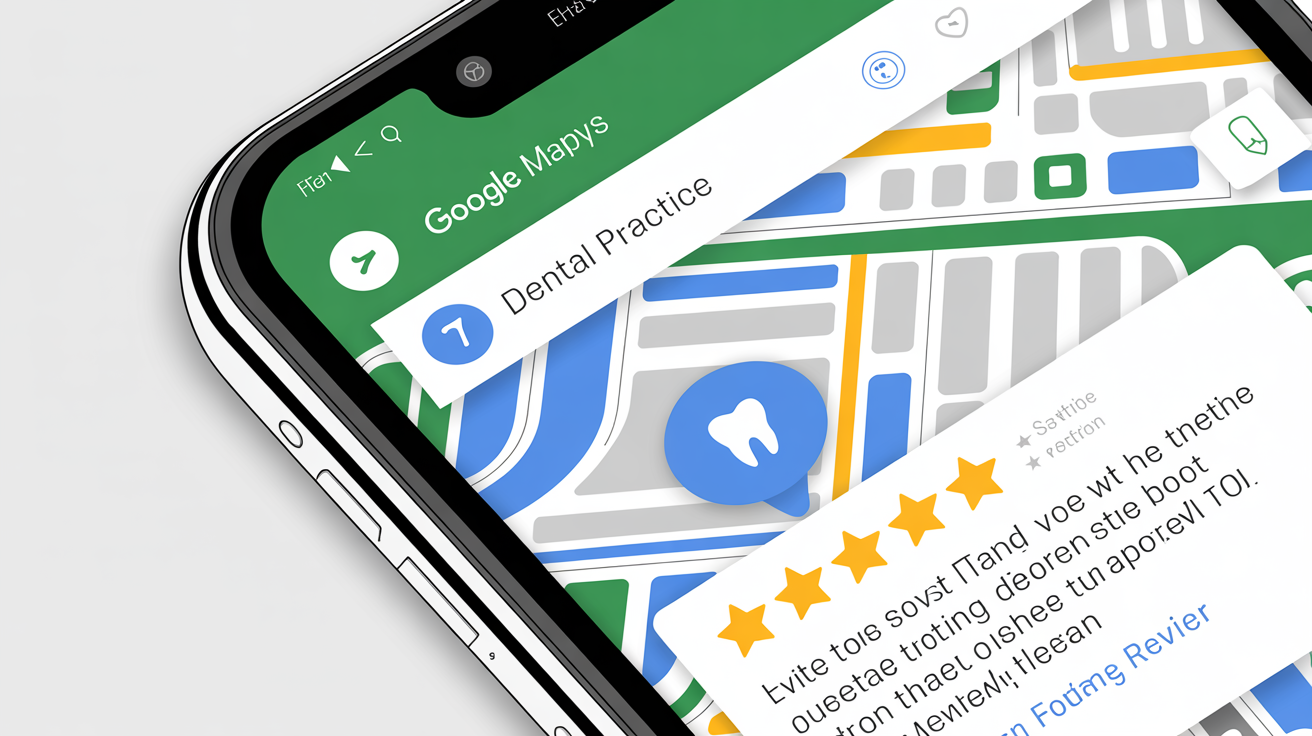
For an Irish dental practice, a fully optimised Google Business Profile returns more than anything else you can do for local search. It is usually the first contact a patient has with you, in the Map Pack above the ordinary results.
- a. Claim and Verify Your Listing:
- Action: Go to google.com/business and search for your practice. If a listing exists, claim it. If not, create one.
- Verification: Google will send a postcard by mail to your physical address with a verification code. Other methods (phone, email) are sometimes available. You cannot manage the profile until it is verified.
- b. Ensure NAPU Consistency (Name, Address, Phone, URL):
- Action: Your practice name, exact address (as it appears on your website and other directories), local phone number, and website URL must be identical across your GBP, website, and all other online citations. Even small variations can cause confusion.
- c. Choose Accurate Primary & Secondary Categories:
- Action: Select the most specific primary category that describes your practice (e.g. “Dentist,” “Cosmetic Dentist,” “Orthodontist”).
- Add relevant secondary categories (e.g. if your primary is “Dentist,” secondary could be “Dental Implants Periodontist,” “Teeth Whitening Service”). Research what your top local competitors are using (tools like PlePer’s GBP Categories can help, or simply inspect competitor listings).
- d. Craft a Compelling Business Description:
- Action: Write a detailed (up to 750 characters, front-load important info) description of your practice.
- Highlight what makes you unique, your key services, and patient benefits.
- Naturally incorporate relevant local keywords (e.g. “trusted family dentist in Swords,” “advanced cosmetic dentistry Dublin”).
- e. Use Google Posts Regularly:
- Action: Use Google Posts to share updates, offers, events, new services, or blog content. You can learn more about if posting on Google My Business helps SEO in our dedicated article.
- Types: “What’s New,” “Offers,” “Events.”
- Posts expire after 7 days (unless event-based), so aim for at least one new post per week. Include a relevant image/video and a Call-to-Action button.
- f. Proactively Manage the Q&A Section:
- Action: Patients (and anyone) can ask questions directly on your GBP listing. Monitor and answer these promptly and accurately.
- Tip: Pre-populate this section by asking and answering the common questions your practice receives (e.g. “Do you offer payment plans?”, “Are you accepting new patients?”, “What are your opening hours on Saturdays?”). This provides valuable information upfront.
- g. Master Your Online Review Strategy:
- Action (Getting Reviews):
- Actively encourage satisfied patients to leave a Google review. Make it easy for them (provide a direct link, you can generate this in your GBP dashboard under “Get more reviews”).
- Ask at the right time (e.g. after a successful treatment).
- Consider subtle in-office reminders or follow-up emails (ensure compliance with any communication consent).
- Action (Responding to Reviews):
- Respond to all reviews, positive and negative, promptly and professionally.
- Thank positive reviewers.
- Address negative reviews empathetically. Acknowledge their concern, take the conversation offline if necessary, and outline steps to resolve it. How you handle negative feedback can be very telling for potential patients.
- Action (Getting Reviews):
- h. Optimise Photos and Videos:
- Action: Upload high-quality photos and videos showcasing your:
- Clinic exterior (for easy identification)
- Reception area and waiting room
- Treatment rooms
- Team members (professional headshots)
- Technology/equipment (if a selling point)
- Your logo and a cover photo.
- Aim for a variety of images. Add new ones regularly.
- Consider adding EXIF geo-tag data to images before uploading (can subtly help with local signals).
- High-quality visuals can also be part of your wider digital marketing, perhaps even involving video production for virtual tours or patient testimonials.
- Action: Upload high-quality photos and videos showcasing your:
- i. Utilise the Products/Services Feature:
- Action: List your key dental services (e.g. “Teeth Whitening,” “Dental Check-up & Clean,” “Invisalign Consultation”) with descriptions and, if applicable, price ranges. This makes it easier for patients to see what you offer directly from your GBP listing.
- j. Enable Booking/Appointment Links:
- Action: If you use an online booking system, add the direct link to your GBP profile. Google may also offer its own booking integration depending on your setup. Make it as easy as possible for patients to book.
- k. Regularly Check GBP Insights:
- Action: Pay attention to your GBP Insights to see how patients are finding you (direct vs. discovery searches), what actions they take (website visits, direction requests, calls), and the performance of your photos and posts. Use this data to refine your strategy.

8. Choosing a Dental SEO Partner and What to Expect
While some DIY SEO is possible, achieving significant results often requires expertise. If considering a dental SEO company or agency in Ireland:
- Look for Dental Niche Experience: Do they understand the unique challenges and opportunities in marketing for Irish dentists? Ask for case studies or examples of their work with other dental practices.
- The Whole Job: They should cover on-page, local, technical, content and off-page SEO (link building), not one of them on its own. You can read more about what is an SEO agency and the services they provide.
- Ethical (White-Hat) Practices: Ensure they don’t use “black-hat” tactics (like buying links or keyword stuffing) that could get your site penalised by Google.
- Transparent Reporting: They should provide clear, regular reports on keyword rankings, organic traffic, conversions (e.g. calls, form submissions from organic traffic), and GBP performance.
- Clear Communication: They should explain their strategies and results in a way you understand.
- Typical Process:
- Initial Consultation & Audit: Understanding your practice, your goals, your current website and your competitors. A full website audit is usually part of it.
- Strategy Development: A customised SEO plan tailored to your specific needs.
- Implementation: Executing on-page, local, technical, and content optimisation tasks.
- Ongoing Optimisation & Link Building: SEO is not a one-time fix. It requires continuous effort, monitoring, and adjustments.
- Reporting & Analysis: Regular tracking and reporting on progress.
9. The Metrics Irish Dentists Should Track
Measuring your SEO tells you what is working and what is not. The Key Performance Indicators (KPIs) that matter.
- Keyword Rankings: Improvement in search engine rankings for your target local and service-based keywords. (Use tools like Google Search Console or paid rank trackers).
- Organic Traffic: Increase in visitors coming from organic (non-paid) search results. (Track in Google Analytics).
- Google Business Profile Insights:
- How customers search for your business (Direct vs. Discovery).
- Where customers view your business on Google (Search vs. Maps).
- Customer actions (Website visits, Direction requests, Calls).
- Photo views.
- Conversion Rate (from Organic Traffic): Percentage of organic website visitors who take a desired action (e.g. book an appointment online, call the practice, fill out a contact form). Set up goals in Google Analytics.
- Number of New Patient Inquiries/Bookings (Attributed to SEO): The ultimate measure. Ask new patients how they found you.
- Click-Through Rate (CTR): Percentage of users who click on your website from the SERPs. (Available in Google Search Console).
- Bounce Rate: Percentage of visitors who leave your site after viewing only one page. (Lower is generally better, but context matters).
- Local Citations & NAP Consistency: Monitor your presence and consistency across key directories.
10. A Roadmap to Growing Your Dental Practice with SEO Solutions
The point of Dental SEO is a practice that keeps growing. Here is the roadmap.
- Set Clear Goals: What do you want to achieve? More calls? More online bookings for specific high-value treatments? Increased visibility in a new service area?
- Invest in a Professional Website: Your website is your online storefront. It must be modern, fast, mobile-friendly, and user-centric. Our page on how much does a website cost will help you budget for it.
- Prioritise Local SEO & Google Business Profile: This is where you’ll see the quickest wins for attracting local patients.
- Develop a Content Strategy: Create high-quality service pages and informative blog content that answers patient questions and targets relevant keywords. Think about common dental concerns in Ireland and address them.
- Build Online Authority & Trust: Focus on acquiring quality local backlinks and encouraging patient reviews.
- Be Patient and Consistent: SEO is a marathon, not a sprint. Significant results take time and consistent effort.
- Consider Professional Help: If you lack the time or expertise, partnering with a reputable dental SEO agency like Bubblehub can accelerate your growth. Our team provides expert SEO services across Ireland, including specific areas like Carlow, Kildare, Kilkenny, and many more.
11. Frequently Asked Questions (FAQ) about Dental SEO in Ireland
- Q: How long does it take to see results from Dental SEO?
- A: While some quick wins (like GBP optimisation) can show results in weeks, significant improvements in organic rankings for competitive keywords typically take 3-6 months, sometimes longer, depending on your current website authority, competition, and the consistency of effort.
- Q: What is the typical cost of Dental SEO services in Ireland?
- A: Costs can vary widely based on the scope of services, the competitiveness of your market, and the agency’s expertise. Monthly retainers can range from a few hundred to several thousand Euros. It’s best to get a custom quote based on your specific needs and goals. Focus on value and ROI, not just the cheapest price.
- Q: Can I do Dental SEO myself, or do I need an agency?
- A: You can certainly implement some basic SEO practices yourself, especially with GBP optimisation and on-page content. However, Dental SEO can be complex and time-consuming. An agency brings specialised expertise, tools, and dedicated resources, often leading to faster and more significant results, especially for technical SEO, advanced keyword strategy, and link building. For a starting point, our guide on where to start with SEO for Irish businesses can be helpful.
- Q: How do I measure the ROI of my Dental SEO campaign?
- A: Track increases in new patient inquiries, calls, and online bookings that can be attributed to organic search. Compare the value of these new patients against the cost of your SEO investment. Tools like Google Analytics (with goal tracking) and call tracking can help attribute conversions.
12. What to Remember for Your Dental Practice
- Dental SEO is how local Irish patients find you, and how the practice grows.
- Prioritise Local SEO, and above all a properly optimised Google Business Profile.
- Strategic keyword research helps you connect with patients actively seeking your services.
- High-quality, informative content builds trust and improves rankings.
- Technical SEO (site speed, mobile-friendliness, security) is foundational.
- Online reviews drive both your rankings and patient trust.
- Consistency and patience are key to long-term SEO success.
- A specialised Dental SEO provider like Bubblehub saves you the time and gets more back from the same spend.
13. Growing Your Irish Dental Practice
Dental SEO puts your practice in front of a patient at the moment they are looking for a dentist. Do that consistently and the diary fills from people who are already searching in your area.
At Bubblehub we build Dental SEO strategies for Irish dentists one practice at a time, and we know the local market you are competing in.
Contact Bubblehub Media for a free consultation. We will look at where your practice ranks now and tell you what would move it.
On budget: our guide to how much SEO costs in Ireland covers what a single practice and a multi-clinic group should expect to pay, and the red flags in cheap dental SEO offers.